A plain bagel contains anywhere from 245 to 400 calories, depending on its size and where it comes from. A standard store-bought bagel, like Thomas’, sits closer to 270 calories, while a hand-rolled New York-style bagel, the kind baked fresh at a local bagel shop, typically lands between 350 and 400 calories because of its larger size and denser dough.
That range matters more than most people realize. Not all bagels are the same size, and the difference between a grocery-store bagel and a true NYC-style bagel can be nearly 150 calories before you’ve added a thing on top. Flavor, toppings, and whether you go for the whole bagel or half all shift the number significantly.
This guide breaks it down completely, every major bagel type, every common topping, and the combinations people ask about most, so you know exactly what you’re eating.
What Is the Average Calorie Count in a Bagel?
The average bagel contains 245-400 calories, with most of those calories coming from carbohydrates. Where your bagel falls in that range depends almost entirely on two things: how it was made and how big it is.
How Many Calories in a Plain Bagel?
A plain bagel is the baseline against which everything else gets measured. A standard supermarket plain bagel, the kind that comes pre-sliced in a bag, typically contains around 270 calories. A deli- or bakery-style plain bagel, hand-rolled and baked fresh, runs about 350-400 calories. The difference isn’t a recipe change; it’s density and size. Freshly made bagels are simply larger and heavier, which means more dough and more calories per piece.
For context, the USDA lists a medium plain bagel (105g) at approximately 270 calories, but most bagels you’ll find at a real bagel shop weigh significantly more than 105g.
How Do Bagel Size and Brand Affect Calories?
Size is the single biggest calorie driver in a bagel, more than flavor or even ingredients. A small packaged bagel might weigh 70 to 80 grams. A large bakery bagel can easily hit 150 grams or more, essentially double the dough, double the calories.
Brand matters for the same reason. Thomas’ plain bagel has 270 calories. A Costco bakery bagel runs around 340 calories. A hand-rolled NYC-style bagel from a local shop can reach 380 to 400 calories, not because the recipe is richer, but because it’s a genuinely larger piece of food. If you’re tracking calories, weighing your bagel gives you a far more accurate number than relying on any generic figure.
How Many Calories in Half a Bagel?
Half a standard plain bagel contains roughly 135 to 200 calories, depending on the size of the whole bagel you started with. If you’re working with a 270-calorie supermarket bagel, half of it is around 135 calories. If you’re slicing a 380-calorie bakery bagel, half is closer to 190 calories. It’s a simple split, but worth knowing because toppings like cream cheese are often applied per half, so the half-bagel calorie count is the more practical number for most people.
How Many Calories in a Mini Bagel?
Mini bagels are the most consistent in size across brands, which makes them easier to track. A single mini bagel typically contains 50-70 calories. Thomas’ mini plain bagels come in at around 50 calories each, while bakery-style minis run slightly higher at 60 to 70 calories. They’re a legitimate lower-calorie option if you want the bagel experience without committing to a full-sized one. However, most people eat two or three, which brings the total back in line with a single regular bagel.
Calories in Every Bagel Type, Complete Flavor Breakdown
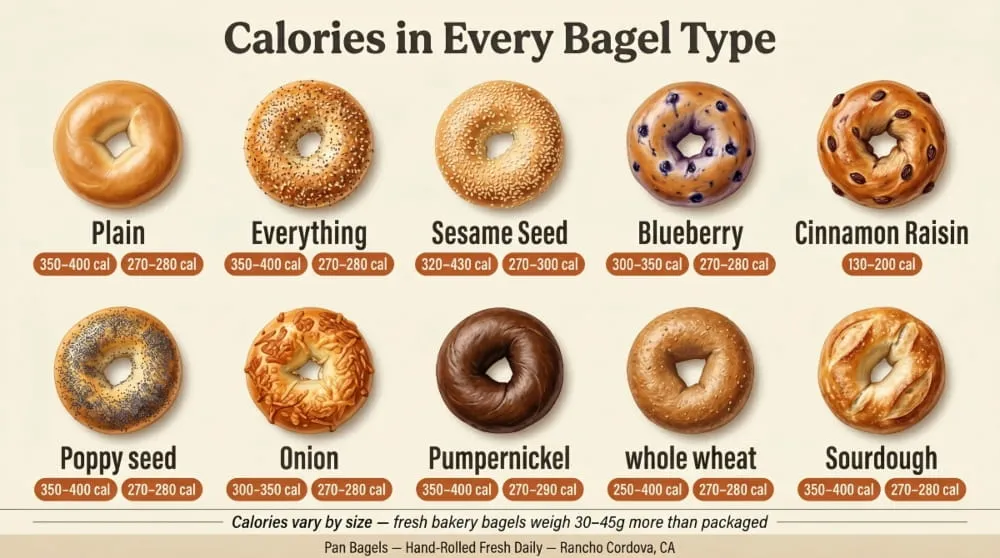
Most bagel flavors are closer in calories than people expect. The base dough accounts for most of the calories, and toppings like sesame or poppy seeds add only a negligible amount. Where you’ll see meaningful differences is in enriched doughs, bagels made with added sugar, fruit, or cheese baked in, which can add 20 to 50 calories over a plain bagel of the same size.
Everything Bagel Calories
An everything bagel contains approximately 270 to 390 calories, nearly identical to a plain bagel of the same size. The seasoning blend, sesame seeds, poppy seeds, dried garlic, dried onion, and salt, adds only around 10 to 15 calories total. What you’re really tasting is a plain bagel with a heavily seasoned crust. A supermarket everything bagel is around 270 to 280 calories; a fresh-baked everything bagel is 350 to 390 calories.
Sesame Seed Bagel Calories
A sesame seed bagel runs about 275 to 395 calories. Sesame seeds add a small amount of healthy fat, nudging the calorie count marginally above a plain bagel by 10 to 20 calories. The difference is minor enough that if you prefer sesame, it’s not a meaningful trade-off calorically.
Blueberry Bagel Calories
A blueberry bagel typically contains 290 to 360 calories, slightly more than a plain bagel because of the added sugar in the dough. Most commercial blueberry bagels use dried blueberries or blueberry flavoring rather than fresh fruit, and the dough is sweetened to balance the flavor. That added sugar is where the extra calories come from, not the fruit itself. Thomas’ blueberry bagel comes in at around 280 calories; a fresh bakery blueberry bagel can reach 340 to 360 calories.
Cinnamon Raisin Bagel Calories
Cinnamon raisin is one of the higher-calorie bagel flavors, typically ranging from 290 to 380 calories. Raisins are naturally high in sugar, and most recipes also add a sweetener to the dough itself. The result is a bagel that runs 20 to 40 calories higher than a plain bagel of equivalent size. If you’re eating one from a bakery rather than a package, expect it to be on the higher end of that range.
Onion Bagel Calories
An onion bagel contains roughly 270 to 380 calories, essentially the same as a plain bagel. Dried onion flakes baked into or onto the dough add almost no calories, so the difference comes down entirely to size and where the bagel was made. Flavor-wise, it’s one of the more distinct bagels; calorically, it’s one of the most neutral.
Poppy Seed Bagel Calories
A poppy-seed bagel runs about 270 to 385 calories. Like sesame seeds, poppy seeds add a small amount of fat, which marginally increases the calorie count, typically 10 to 15 calories above a plain bagel. The effect on your daily calorie intake is negligible. A standard packaged poppy-seed bagel lands around 270 to 280 calories; a fresh bakery version sits closer to 370 to 385 calories.
Asiago Bagel Calories
Asiago is one of the highest-calorie bagel types, typically ranging from 310 to 420 calories. The cheese baked into the dough and crusted on top adds meaningful fat and protein, which significantly raises the calorie count compared with plain or seed-topped bagels. Panera’s asiago bagel, for reference, contains around 310 calories, but a larger bakery-made asiago bagel can easily reach 400 calories or more.
Pumpernickel Bagel Calories
A pumpernickel bagel contains approximately 260-370 calories. Pumpernickel dough is made with rye flour and often molasses, which give it its dark color and a slightly lower glycemic profile than white-flour bagels. The calorie difference versus a plain bagel is minimal, usually within 10 to 20 calories, but pumpernickel does offer more fiber, which some people find more satiating per calorie.
Whole Wheat Bagel Calories
A whole wheat bagel typically contains 260 to 370 calories, roughly on par with a plain white flour bagel of the same size. The calorie difference between whole wheat and plain is small, often fewer than 20 calories either way. Where whole wheat has a genuine advantage is fiber content, with most whole wheat bagels delivering 3 to 5 grams of fiber compared to 1 to 2 grams in a standard plain bagel. More fiber means slower digestion and longer satiety, which matters more than the marginal calorie gap.
Sourdough Bagel Calories
A sourdough bagel contains approximately 270 to 380 calories. Sourdough fermentation doesn’t significantly reduce calories, though some research suggests it may slightly lower the bread’s glycemic impact. Calorically, it sits in the same range as a plain bagel. The flavor is notably tangier and the texture denser, which many people find more satisfying, potentially making it easier to eat just one.
Multigrain & Gluten-Free Bagel Calories
A multigrain bagel typically contains 260 to 350 calories. It offers the best nutritional profile of any standard bagel, with higher fiber, more micronutrients, and a more complex carbohydrate structure than white-flour varieties.
Gluten-free bagels are a different story. Most gluten-free bagels contain 200 to 320 calories, but they vary widely depending on the flour blend used. Rice flour, tapioca starch, and potato starch are common substitutes, and some blends result in a denser, higher-calorie product than others. Gluten-free bagels are a necessity for people with celiac disease or gluten sensitivity, not inherently a lower-calorie choice for everyone else.
Calories in a Bagel with Cream Cheese
A bagel with cream cheese typically contains between 350 and 550 calories, depending on the bagel’s size and how generously the cream cheese is spread. It’s one of the most searched bagel combinations for good reason; cream cheese is the default topping at virtually every bagel shop, and its calorie contribution is significant enough to matter if you’re paying attention.
How Much Does Cream Cheese Add?
Understanding cream cheese as a separate variable makes the other numbers in this section easier to read.
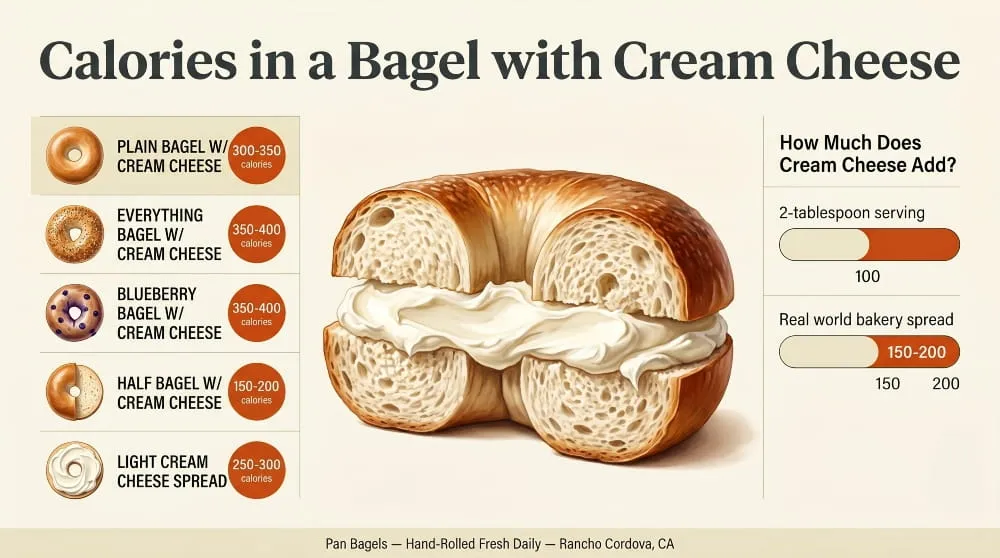
A standard serving of cream cheese is 2 tablespoons, weighing about 29 grams and containing roughly 100 calories. In practice, most bagel shops spread considerably more than that. A typical deli or bakery application runs closer to 2 to 3 ounces, 55 to 85 grams, which translates to 200 to 300 calories from cream cheese alone, before the bagel is even counted.
That gap between “standard serving” and “real-world application” is where most calorie estimates go wrong. If you’re tracking accurately, the safest assumption for a bagel shop cream cheese spread is 150 to 200 calories, not the 100 calories listed on a nutrition label for a controlled 2-tablespoon portion.
Light cream cheese cuts that number by roughly 30 to 35 percent, around 60 to 70 calories per 2-tablespoon serving, but again, the amount applied matters more than the variety chosen.
Plain Bagel with Cream Cheese Calories
A plain bagel with cream cheese contains approximately 370 to 550 calories. A packaged plain bagel at around 270 calories, combined with a moderate cream cheese spread at 150 calories, lands near 420 calories. A larger hand-rolled bakery bagel at 380 calories with a generous spread reaches 530 to 550 calories.
This is the combination most people picture when they think of a classic bagel breakfast, and it’s genuinely filling. The combination of complex carbohydrates from the bagel and fat from the cream cheese creates a meal that holds most people for three to four hours, not surprising for something in the 400 to 500 calorie range.
Everything Bagel with Cream Cheese Calories
An everything bagel with cream cheese ranges from 380 to 560 calories. The everything bagel itself adds only marginally more calories than a plain bagel, roughly 10 to 15 calories for the seasoning blend, so the total stays close to the plain bagel with cream cheese range. The reason this combination gets its own search volume is partly flavor preference and partly because everything bagels are the most commonly ordered style at NYC-style bagel shops, making it the de facto “standard” bagel experience for many people.
A bakery-made everything bagel at 370 calories with a real-world cream cheese spread of 180 calories puts you right around 550 calories for a complete, satisfying breakfast.
Blueberry Bagel with Cream Cheese Calories
A blueberry bagel with cream cheese contains approximately 390 to 520 calories. The blueberry bagel’s slightly higher sugar content, typically 20 to 40 calories more than a plain bagel, is the only meaningful difference from the plain bagel calculation. The cream cheese addition follows the same logic as any other variety.
It’s worth noting that the sweet-savory contrast of blueberry and cream cheese is a genuinely popular combination, but, nutritionally, it’s sweeter than most bagel pairings. If you’re conscious of your sugar intake, a plain or whole-wheat bagel with cream cheese has a similar calorie count with less added sugar in the dough.
Half a Bagel with Cream Cheese Calories
Half a bagel with cream cheese typically contains 185-280 calories, making it one of the more practical lower-calorie breakfast options built around real food rather than diet substitutes.
The math is straightforward: half a standard supermarket plain bagel at around 135 calories plus one tablespoon of cream cheese at roughly 50 calories puts you at approximately 185 calories. Half a larger bakery bagel at 190 calories with a more generous spread of 80 to 90 calories lands closer to 270 to 280 calories.
For people who want a bagel without the full-calorie commitment, a half of a fresh-baked bagel with cream cheese is a more satisfying option than a full mini bagel or a packaged bagel thin. The quality of the bread makes the smaller portion feel intentional rather than like a compromise.
New York-Style Bagel Calories: Are They Higher?
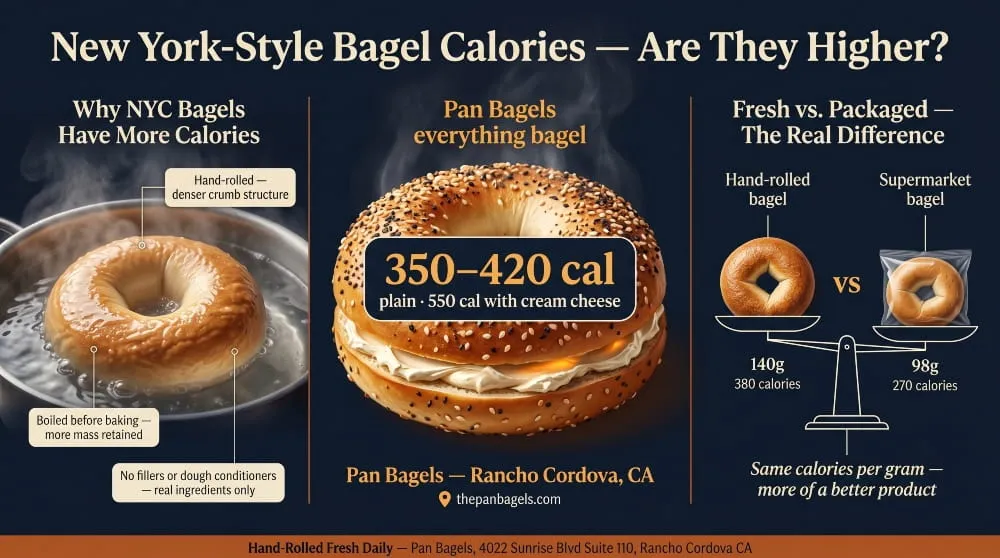
Yes, a New York-style bagel is higher in calories than a store-bought bagel, and the difference is substantial. Most NYC-style bagels contain between 350 and 420 calories plain, compared to 260 to 280 calories for a standard packaged bagel. That gap isn’t a flaw in the recipe. It’s a direct result of how a real bagel is supposed to be made.
Why NYC Bagels Have More Calories Than Store-Bought
The calorie difference between a New York-style bagel and a grocery-store bagel comes down to three factors: size, dough density, and process.
A traditional NYC bagel is hand-rolled, meaning the dough is shaped by hand, not extruded by a machine. Hand-rolling produces a denser, tighter crumb structure with more dough per square inch than a factory-pressed bagel. The result is a heavier bagel; most authentic NYC-style bagels weigh between 120 and 150 grams, compared to 90 to 105 grams for a standard packaged bagel. That 30 to 45 gram difference alone accounts for 80 to 120 additional calories.
The second factor is boiling. Traditional bagels are boiled in water, sometimes with a small amount of malt or honey added, before baking. This step creates the characteristic chewy crust and dense interior that defines the style. It also means the bagel retains more structure and mass than a bagel that skips the boil, which many commercial brands do to cut production time.
The third factor is simply that authentic bagels don’t use fillers, emulsifiers, or dough conditioners to inflate volume artificially. What you’re eating is flour, water, yeast, salt, and malt, nothing that inflates the size without adding corresponding substance. More real food means more real calories.
Pan Bagels’ Hand-Rolled Bagels: What’s Actually In Them?
Pan Bagels in Rancho Cordova makes its bagels the traditional way, hand-rolled daily from scratch, boiled before baking, with no shortcuts in the process. That means you’re getting a bagel that weighs and eats like a real NYC-style bagel, not a scaled-down commercial approximation.
A plain hand-rolled bagel from Pan Bagels sits in the 350 to 400 calorie range, consistent with what you’d find at a proper bagel shop in New York. Add cream cheese, and you’re looking at a complete breakfast in the 500 to 550 calorie range, with enough protein and fat to sustain you through a full morning.
What’s in them is straightforward: quality dough, real ingredients, baked fresh each day. Pan Bagels also carries everything bagels, sesame bagels, and specialty flavors, plus their house donuts and boba, for a full menu that goes well beyond breakfast. You can see the full menu at thepanbagels.com or order for delivery across Rancho Cordova through DoorDash and Grubhub.
Fresh vs. Packaged Bagel Calories: The Real Difference
The calorie gap between a fresh bagel and a packaged one is real, but it reflects quality rather than excess. A Thomas’ plain bagel contains 270 calories and weighs roughly 98 grams. A freshly made hand-rolled bagel at 380 calories weighs around 140 grams. The calorie-per-gram ratio is actually similar, approximately 2.7 calories per gram in both cases. You’re not eating a richer product. You’re eating more of a better one.
Packaged bagels also contain preservatives, dough conditioners, and stabilizers to extend shelf life, ingredients that don’t appear in a scratch-made bagel but also don’t meaningfully change the calorie count. The practical difference is that a fresh bagel is denser, more filling, and typically more satisfying per bite, which means many people find they eat less overall when the quality is higher.
If calorie-for-calorie satisfaction is your measure, a fresh NYC-style bagel from a local shop tends to outperform its packaged equivalent, not because the numbers are lower, but because the eating experience is more complete.
Bagel with Toppings, Full Calorie Breakdown
What you put on a bagel often adds more calories than the bagel itself. Toppings range from a modest 50-calorie butter spread to a full lox-and-cream-cheese combination that can push a single bagel past 600 calories. Knowing what each topping contributes lets you build the breakfast you actually want without being surprised by the total.
Bagel with Butter Calories
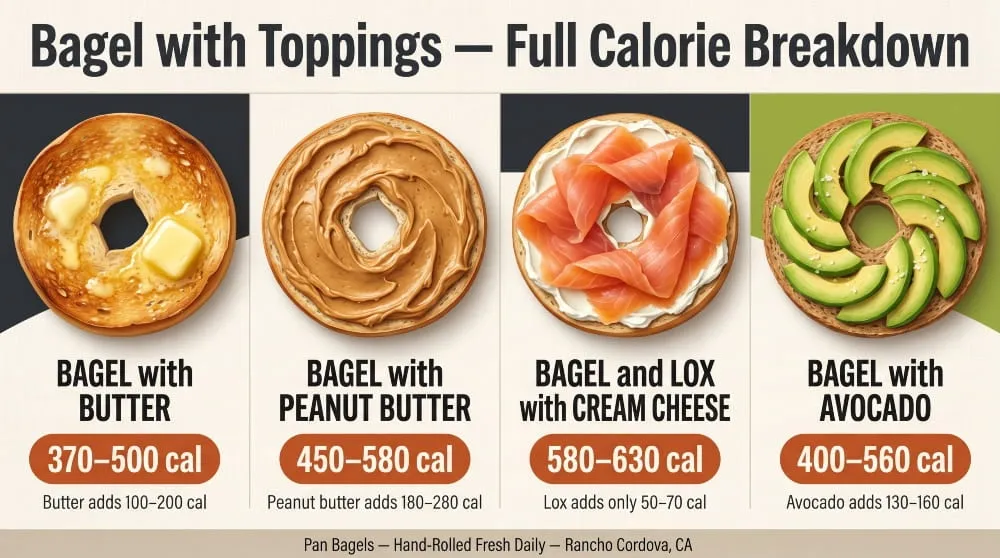
A bagel with butter contains approximately 320 to 470 calories, depending on the bagel’s size and the amount of butter applied. A single tablespoon of butter adds around 100 calories, and most people spread between one and two tablespoons across both halves, so the realistic butter addition is 100 to 200 calories on top of the bagel’s base count.
A standard supermarket plain bagel at 270 calories with one tablespoon of butter lands around 370 calories. A larger hand-rolled bakery bagel at 380 calories with a generous butter spread reaches 470 to 500 calories. Butter adds primarily fat, about 11 grams per tablespoon, with essentially no protein or carbohydrates, which means it contributes calories without adding much satiety on its own. Most people find that a buttered bagel holds them for less time than the same bagel with cream cheese or peanut butter.
Bagel with Peanut Butter Calories
A bagel with peanut butter typically contains between 450 and 580 calories, making it one of the higher-calorie topping combinations, but also one of the most nutritionally complete. Two tablespoons of peanut butter, which is the standard serving and roughly what most people spread on a bagel, contains approximately 190 calories, 8 grams of protein, and 16 grams of fat.
That protein-and-fat combination is meaningful. A bagel with peanut butter delivers a more sustained energy release than a bagel with butter or even cream cheese, because peanut butter’s protein content slows digestion and blunts the carbohydrate spike from the dough. For people who eat breakfast and need to go several hours before their next meal, this is one of the most functional bagel combinations calorically, more food, but food that works harder.
A supermarket bagel at 270 calories plus two tablespoons of peanut butter puts you at around 460 calories. A fresh bakery bagel at 380 calories with the same spread reaches 570 calories, a genuinely substantial breakfast by any measure.
Bagel and Lox with Cream Cheese Calories
A bagel with lox and cream cheese contains approximately 450 to 650 calories, making it the most calorie-variable combination in this section because it involves three separate components with their own ranges.
The breakdown works like this: the bagel itself contributes 270 to 400 calories, depending on size and style. A real-world cream cheese spread adds 150-200 calories. And lox, cold-smoked salmon, adds approximately 50 to 70 calories per two-ounce serving, along with around 11 grams of protein and a meaningful dose of omega-3 fatty acids.
The lox is actually the most nutritionally efficient part of the combination. At roughly 25 calories per ounce, smoked salmon adds flavor, protein, and healthy fat for a relatively small calorie cost. The cream cheese has a higher calorie content. A classic bagel and lox order at a NYC-style shop, a hand-rolled bagel, a generous cream cheese spread, and two ounces of lox, lands somewhere between 580 and 630 calories. It’s a high-calorie meal by breakfast standards, but it also provides complete protein, healthy fats, and complex carbohydrates in a single order.
Bagel with Avocado Calories
A bagel with avocado contains approximately 400-560 calories, depending on how much avocado is used and whether anything else is added. Half a medium avocado, the typical serving on an avocado bagel, contains around 120 calories, 10 grams of fat, and 5 grams of fiber. A whole avocado spread runs closer to 240 calories.
The fiber content is worth noting. Half an avocado contributes 5 grams of dietary fiber on top of whatever the bagel provides, which means it significantly increases meal satiety relative to butter or a thin cream cheese spread at a similar calorie count. A supermarket plain bagel at 270 calories, with half an avocado and a pinch of salt, lands around 390-400 calories. A fresh bakery bagel at 380 calories with the same topping reaches 500 calories, a nutritionally solid breakfast that delivers healthy fat, fiber, and complex carbohydrates without the protein gap that a buttered bagel leaves.
If you’re adding extras like a fried egg, red pepper flakes, or everything bagel seasoning on top, account for an additional 70 to 90 calories for the egg and negligible calories for the seasoning.
Bagel Breakfast Sandwich Calories
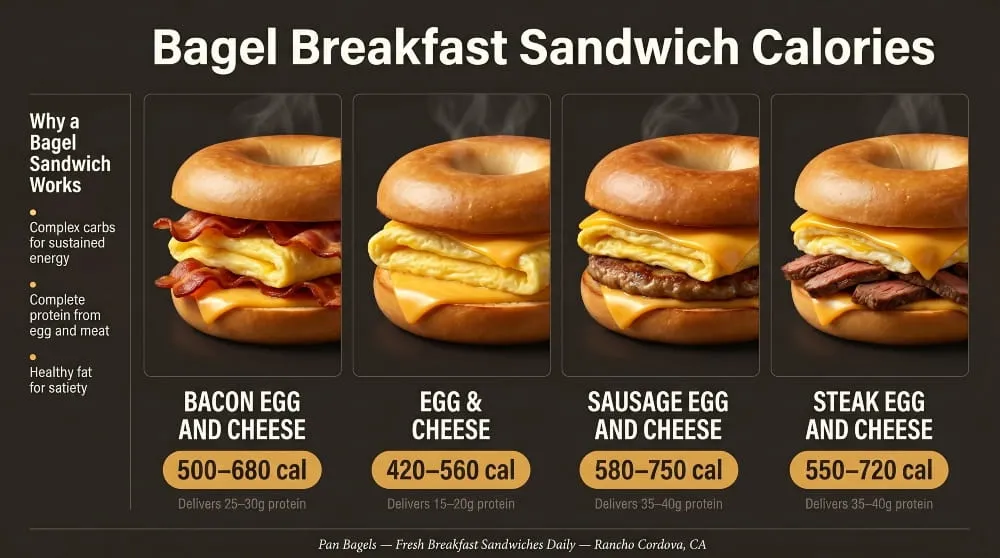
A bagel breakfast sandwich typically contains between 450 and 750 calories, making it one of the most calorie-dense ways to eat a bagel, and also one of the most complete meals you can have before noon. The protein from eggs, meat, and cheese, combined with the carbohydrates from the bagel, creates a breakfast that holds most people comfortably through a full morning of work.
Bacon, Egg & Cheese Bagel Calories
A bacon, egg, and cheese bagel contains approximately 500-680 calories, depending on the bagel size and the proportions of each ingredient. It’s the most ordered bagel breakfast sandwich in the country, and for good reason, the combination of fat, protein, and carbohydrates is genuinely well-balanced for a morning meal.
The components break down like this: a plain bagel contributes 270 to 400 calories, depending on whether it’s packaged or fresh. Two strips of bacon add approximately 80-90 calories. One large fried or scrambled egg adds around 90 calories. A slice of American cheese adds roughly 60 to 70 calories. Put those together on a supermarket bagel, and you’re at approximately 500 calories. In a hand-rolled bakery bagel, the same build ranges from 630 to 660 calories.
That calorie range also delivers around 25 to 30 grams of protein, enough to meaningfully blunt hunger for several hours. For an active person eating breakfast before a full day, a bacon, egg, and cheese on a fresh bagel is a high-calorie meal that earns its keep.
Egg & Cheese Bagel Calories
An egg and cheese bagel contains approximately 420 to 560 calories, making it the leanest of the hot breakfast sandwich options and a solid choice if you want the satisfaction of a built bagel without the added fat from cured meat.
One large egg contributes around 90 calories and 6 grams of protein. A slice of cheese, American, cheddar, or Swiss, adds 60 to 80 calories and another 4 to 5 grams of protein. Combined with a fresh bakery bagel at 370 to 400 calories, the total ranges from 520 to 560 calories and provides approximately 20 grams of protein. On a standard supermarket bagel, the same sandwich comes in closer to 420 to 430 calories.
It’s a quieter sandwich than the bacon or sausage versions, but the egg-to-bagel ratio makes it the most egg-forward option, which is worth noting if the egg is the part you’re there for.
Sausage, Egg & Cheese Bagel Calories
A sausage, egg, and cheese bagel typically contains 580-750 calories, making it the highest-calorie standard breakfast sandwich in this category. Sausage is the variable that drives that number; a standard sausage patty used in breakfast sandwiches contains approximately 170 to 200 calories and 8 to 10 grams of fat, compared to 80 to 90 calories for two strips of bacon.
The trade-off is protein. A sausage patty also delivers 9 to 11 grams of protein, which, combined with the egg and cheese, puts the total protein content of this sandwich at 28 to 35 grams, the highest of any combination in this section. For someone doing physical work or heading into a long stretch without another meal, that protein density makes the higher calorie count a reasonable trade. A sausage, egg, and cheese on a fresh hand-rolled bagel is a serious breakfast by any measure, north of 700 calories, but built from ingredients that do actual work.
Steak, Egg & Cheese Bagel Calories
A steak, egg, and cheese bagel contains approximately 550 to 720 calories, sitting between the bacon and sausage versions depending on how the steak is prepared and portioned. Steak, typically thin-sliced sirloin or shaved beef, runs around 150 to 180 calories per three-ounce serving and contributes significantly more protein than either bacon or sausage at a comparable calorie cost.
Three ounces of lean beef delivers approximately 22 grams of protein at around 150 calories, which makes steak one of the most calorie-efficient proteins you can put on a breakfast sandwich. The full sandwich, steak, egg, cheese, and a fresh bakery bagel, lands around 650 to 700 calories with a total protein content of 35 to 40 grams. That’s a meal, not just a breakfast. It’s also the combination that tends to appear on menus at serious bagel shops rather than fast food chains, which is part of what makes it feel like a more intentional order.
Low-Calorie Bagel Options: What to Know
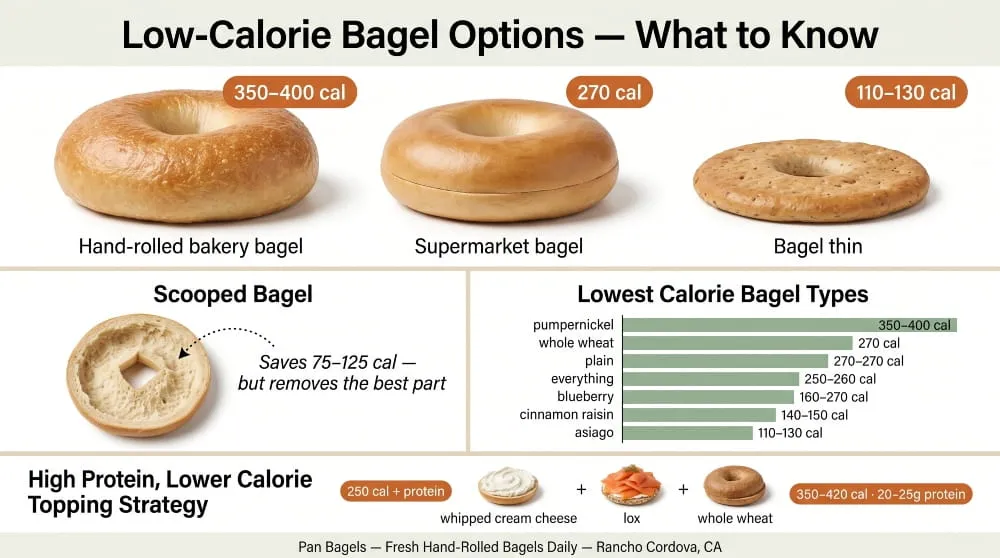
The lowest-calorie bagel is still a bagel, meaning there’s a floor below which you can’t go without fundamentally changing what you’re eating. That floor sits around 110 to 130 calories for the thinnest commercial options, compared to 270 to 400 calories for a standard bagel. The strategies that actually work for reducing bagel calories are fewer than most people think, and some popular ones are less effective than they appear.
Lowest Calorie Bagel Types Ranked
Across standard bagel varieties, the calorie differences between flavors are smaller than most people expect, typically within 20 to 40 calories per bagel at the same size. Size and freshness matter far more than flavor when it comes to calorie count. That said, within the same size category, here’s how the major types compare from lowest to highest:
Pumpernickel and whole wheat bagels tend to come in at the lower end of the calorie range for their size, typically 260 to 370 calories, while also delivering more fiber than white flour varieties. Plain and onion bagels are next, sitting in the 270 to 380 calorie range with no added sugars in the dough. Everything and sesame bagels add marginally more calories from their seed toppings, usually 10 to 20 calories above a plain bagel of equivalent size. Blueberry and cinnamon raisin bagels sit at the higher end due to added sugars in the dough, typically adding 20 to 50 calories to a plain bagel of the same size. Asiago and cheese-enriched bagels are consistently the highest-calorie variety, running 30 to 60 calories above a plain bagel due to the fat in the baked-in cheese.
The honest takeaway is that if you want fewer calories from a bagel, choosing pumpernickel over blueberry saves you perhaps 40 calories, meaningful only if every calorie counts. Choosing a smaller bagel saves you 100-150 calories. That’s where the real leverage is.
Bagel Thins vs. Regular Bagels, Calorie Difference
Bagel thins contain approximately 110 to 130 calories per piece, compared to 270 to 400 calories for a standard bagel. That’s a genuine and significant calorie reduction, roughly 55 to 65 percent fewer calories than a full-sized bagel, and it’s the most straightforward low-calorie bagel swap available in a packaged format.
The trade-off is texture and satiety. A bagel thin is essentially a flat disc of bagel dough with a hole in the center. It toasts well and holds toppings, but it doesn’t replicate the chew, density, or crust of a real bagel. Thomas’ Bagel Thins, one of the most widely available options, come in at 110 calories per thin and are designed specifically for people who want the bagel format with a significantly reduced calorie load.
Whether that trade-off is worth it depends entirely on what you’re after. If you want a lower-calorie vehicle for eggs and cheese, a bagel thin is a practical solution. If you want the experience of eating a real bagel, a bagel thin is a different product that happens to share a name.
Scooped Bagel Calories: Does It Actually Help?
Scooping a bagel, removing the soft interior dough and eating only the crust shell reduces its calorie count by approximately 75 to 125 calories, depending on the size of the bagel and how thoroughly it’s scooped. A 380-calorie hand-rolled bagel that’s been scooped lands somewhere around 260 to 300 calories, which is a real reduction but leaves you with a hollow shell rather than a bagel.
The practice became popular in New York in the 1990s and continues to generate strong opinions. From a pure calorie standpoint, it works; you’re literally removing food. From a satisfaction standpoint, most people find that removing the interior dough makes the bagel significantly less filling, because that dense crumb is where much of the satiety comes from. You end up eating fewer calories but feeling less satisfied, which for many people leads to eating more later.
There’s also a practical argument against it at a quality bagel shop: the interior of a hand-rolled, fresh-baked bagel is the best part. Scooping a Thomas’ bagel is a different conversation than scooping a bagel that someone made by hand that morning.
High-Protein, Lower-Calorie Bagel Tips
The most effective way to make a bagel meal lower in calories without sacrificing satisfaction is to shift the topping composition rather than reduce the bagel itself. Specifically, increasing the protein content of what goes on the bagel makes the overall meal more satiating per calorie, which means you’re less likely to eat again within an hour or two.
A few approaches that actually move the needle: swapping full-fat cream cheese for a whipped or light version saves 30 to 50 calories per serving while maintaining the spread texture. Adding two or three slices of smoked salmon or lox to any bagel adds only 50 to 70 calories while contributing 11 to 15 grams of protein, one of the best calorie-to-protein ratios of any common bagel topping. Choosing a plain or whole-wheat bagel over a cinnamon-raisin or asiago bagel saves 20 to 50 calories without changing the topping strategy at all.
The combination that delivers the most nutrition for the fewest calories is a whole-wheat or plain bagel, half if you’re watching portions, with whipped cream cheese and 2 ounces of lox. That combination lands around 350 to 420 calories, with 20 to 25 grams of protein, fiber from the whole-wheat dough, and healthy omega-3 fats from the salmon. It’s not a diet food. It’s just a well-constructed bagel.
Where to Find Fresh, Hand-Rolled Bagels in Rancho Cordova
If you’re in Rancho Cordova and want a bagel that actually matches what this guide describes, hand-rolled, boiled, baked fresh daily, Pan Bagels on Sunrise Boulevard is the real thing. Every bagel is made from scratch the same morning you eat it, in the NYC tradition, alongside scratch donuts, boba, and locally roasted coffee.
Visit at 4022 Sunrise Blvd, Suite 110, Rancho Cordova, CA 95742, view the full menu at thepanbagels.com, or order delivery through DoorDash and Grubhub. Open Monday through Sunday, come early, fresh bagels go fast.
Frequently Asked Questions (FAQ’s)
Are Bagels Fattening?
Bagels are not inherently fattening; no single food is. A plain bagel contains 270 to 400 calories, which is a meaningful portion of a daily intake but not an unusual one for a complete breakfast. Weight gain comes from total calorie surplus over time, not from eating bagels specifically.
How Many Calories Should a Bagel Be?
A reasonable bagel sits between 270 and 400 calories before toppings, enough to provide sustained energy without exceeding a quarter of a standard 2,000-calorie daily intake in one item. Anything significantly above 400 calories is typically a function of size rather than ingredients, and worth factoring in if you’re adding toppings.
Is a Bagel Healthier Than Bread?
Two slices of standard white sandwich bread contain roughly 140 to 160 calories combined, significantly less than most bagels, which means a bagel is more calorie-dense than bread by volume. However, a fresh bagel made with quality ingredients, with no preservatives or additives, compares favorably to heavily processed sandwich bread in terms of ingredient quality, even if the calorie count is higher.
What Is the Healthiest Bagel Topping for Fewer Calories?
Lox, smoked salmon, is the most nutritionally efficient bagel topping available, adding only 50 to 70 calories per two-ounce serving while delivering 11 to 15 grams of protein and heart-healthy omega-3 fatty acids. Whipped cream cheese is the next best option, cutting roughly 30 to 40 percent of the calories of regular cream cheese while maintaining the same spreadability.
Can I Eat a Bagel on a Diet?
Yes, a bagel fits into virtually any diet that isn’t specifically carbohydrate-restricted. The practical approach is to treat a fresh bagel as a complete meal rather than a side item, pair it with a high-protein topping like lox or eggs, and account for the full calorie count, including toppings, rather than estimating low.