High-protein bagels are bagels specifically formulated or homemade that deliver significantly more protein per serving than a standard bagel, typically ranging from 15 to 25 grams of protein, compared to the 9 to 11 grams found in a conventional plain bagel. Whether you’re buying a store brand like Thomas’ High Protein or making the viral two-ingredient version at home with Greek yogurt, the goal is the same: a satisfying, carb-based meal that actually moves the needle on your daily protein intake.
Bagels have always contained more protein than most people expect. A plain bagel averages around 10 grams before you add a single topping. Still, the growing category of purpose-built protein bagels takes that baseline and doubles it, often using ingredients like Greek yogurt, cottage cheese, high-protein flour blends, or plant-based protein to get there. The result is a food that fits cleanly into high-protein diets, weight loss plans, and muscle-building routines without asking you to give up one of the most satisfying breakfast foods on the planet.
This guide covers everything: how much protein is actually in different types of bagels, which store-bought brands deliver real protein versus marketing spin, and the best homemade protein bagel recipes, including the Greek yogurt method, the cottage cheese method, and a range of dietary variations from gluten-free to keto to vegan. Every section is built to give you a direct, useful answer, whether you landed here looking for a recipe, a nutrition breakdown, or simply trying to figure out which bagel at the grocery store is actually worth buying.
What Are High-Protein Bagels? (And Why Do Bagels Have So Much Protein?)
A high-protein bagel is any bagel, store-bought or homemade, engineered to deliver meaningfully more protein than a standard bagel, usually achieved by swapping or supplementing traditional ingredients with high-protein alternatives like Greek yogurt, cottage cheese, high-protein flour, or added protein blends. The term covers both commercially produced products (brands like Thomas’, Dave’s Killer Bread, and Sola) and the wave of homemade recipes that have gone viral for producing a legitimate, chewy bagel with minimal ingredients and a serious protein punch.
What makes protein bagels interesting isn’t that they invented something new; it’s that they took a food already surprisingly high in protein and pushed it into territory that competes with eggs, Greek yogurt, and protein shakes as a genuine high-protein morning option.
Why Do Bagels Have More Protein Than Bread?
Bagels naturally contain more protein than most breads because of how they’re made. A standard bagel uses a dense, low-hydration dough, far less water relative to flour than a sandwich loaf, which means you’re eating significantly more flour per serving. Since wheat flour is itself a source of protein (primarily glutenin and gliadin, the proteins that form gluten), that higher flour density translates directly into more protein per piece.
The boiling process also matters. Traditional bagels are boiled before baking, which creates their signature chewy crust and compact crumb. That density isn’t just texture, it’s mass. A single plain bagel typically weighs between 90 and 120 grams, while two slices of standard sandwich bread weigh around 50 to 60 grams combined. You’re eating more, so you’re getting more protein, even before any high-protein modifications come into play.
Where Does the Protein in Bagels Come From?
In a conventional bagel, virtually all of the protein comes from wheat flour. Bread flour, the variety most often used in bagel recipes, contains roughly 12 to 14 grams of protein per 100 grams, making it one of the higher-protein flour options available. A standard plain bagel made with bread flour and water delivers 9 to 11 grams of protein before any toppings are added.
High-protein bagels build on that foundation by adding additional protein sources at the ingredient level. Greek yogurt contributes casein and whey protein, cottage cheese adds a dense hit of casein, almond flour brings plant-based protein alongside healthy fats, and commercial brands often incorporate isolated protein blends, whey, pea, or soy, directly into the dough. Some recipes use a combination: Greek yogurt plus high-protein flour, or cottage cheese plus almond flour. Each method changes the texture slightly, but the protein outcome is similar: a bagel that lands between 15 and 25 grams per serving.
How Much Protein Is in a Regular Bagel vs. a Protein Bagel?
The gap is significant and worth understanding before making a purchase or recipe decision. A plain, store-bought bagel from a standard brand delivers roughly 9 to 11 grams of protein. An everything bagel sits in a similar range. Egg bagels, despite their name, tend to add only 1 to 2 extra grams because the egg content in commercial doughs is relatively modest.
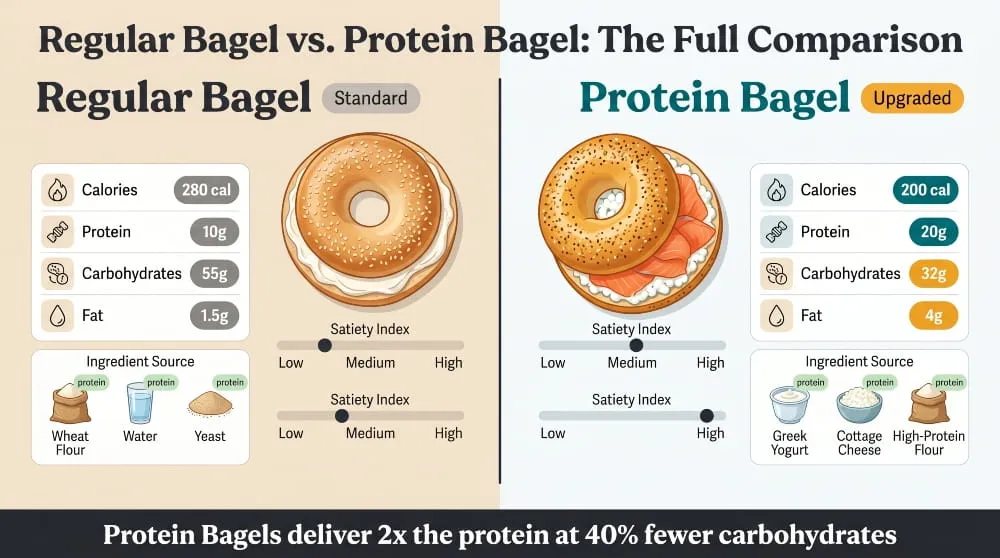
High-protein bagels change that equation substantially. Thomas’ High Protein bagels, one of the most widely available options, deliver around 17 to 20 grams per bagel, depending on the variety. Homemade Greek yogurt bagels made with self-rising flour typically contain 12 to 17 grams, depending on the yogurt brand and serving size. Cottage cheese-based recipes can push higher, some hitting 20 grams or more when full-fat or high-protein cottage cheese is used. Specialty brands like The Better Bagel advertise up to 25 grams per bagel, though these tend to use isolated protein blends and have a noticeably different texture than a traditional bagel.
The practical takeaway: a high-protein bagel can contain roughly double the protein of a regular one, a meaningful difference for anyone tracking intake seriously.
Are Protein Bagels Actually Healthy?
For most people, yes, with context. High-protein bagels are a legitimate functional food, not a gimmick. Protein is the most satiating macronutrient, and research consistently shows that higher-protein breakfasts reduce total calorie intake later in the day. A bagel that delivers 17 to 20 grams of protein first thing in the morning is genuinely working in your favor on that front.
The nuance comes in what else the bagel contains. Store-bought high-protein bagels often include additives, stabilizers, and isolated protein concentrates that boost the protein content but lower overall ingredient quality. Homemade versions made with Greek yogurt or cottage cheese are typically cleaner, with fewer ingredients, more whole-food protein sources, and no preservatives, but require some effort and don’t have the same shelf life.
Carbohydrate content is the other consideration. Most high-protein bagels still contain 30 to 45 grams of carbohydrates, which fits comfortably into a balanced diet but won’t suit strict low-carb or ketogenic eating without modifications. Specialty low-carb protein bagels (almond flour, keto-formulated blends) do exist and bring carbs down to 5 to 10 grams, though the texture trades off against a traditional bagel in ways that are worth knowing before you commit to a batch.
The bottom line: a high-protein bagel made with quality ingredients, whether homemade or from a reputable brand, is a sound, satisfying choice for anyone who wants real protein in a format that doesn’t feel like diet food.
How Much Protein Is in a Bagel? (Every Type, Measured)
The amount of protein in a bagel depends on three things: the type of bagel, the size, and what you put on it. A standard plain bagel from a grocery store delivers around 9 to 11 grams of protein on its own, but once you factor in variety, toppings, and fillings, that number can climb to 30 grams or more in a single meal. Here’s exactly what you’re working with, broken down by type.
Quick Reference: Protein in Every Type of Bagel
| Bagel Type | Protein (bagel only) | Notes |
|---|---|---|
| Plain bagel | 9–11g | Baseline reference |
| Everything bagel | 9–11g | Same dough, seeds add negligible protein |
| Egg bagel | 10–12g | Marginal increase from egg content |
| Whole wheat bagel | 10–12g | Slightly higher than plain |
| Blueberry bagel | 8–10g | Fruit addition slightly dilutes protein density |
| Cinnamon raisin bagel | 8–10g | Similar to blueberry |
| Sourdough bagel | 9–11g | Fermentation doesn’t change protein meaningfully |
| Sesame bagel | 10–11g | Sesame seeds add ~0.5–1g |
| Bagel thin | 5–7g | Smaller size, proportionally less protein |
| Bagel + cream cheese (2 tbsp) | 12–14g | Cream cheese adds ~2g per 2 tbsp |
| Lox bagel (bagel + cream cheese + smoked salmon) | 20–24g | Salmon is the protein driver here |
| Bacon, egg & cheese bagel | 25–30g | Egg + bacon + cheese stack up fast |
| Steak, egg & cheese bagel | 30–38g | Highest protein of all common configurations |
All figures are based on a standard-size bagel (~105g) unless noted. Values are approximate and vary by brand and preparation.
Plain Bagel Protein Content
A plain bagel is the protein baseline, against which everything else is measured. Made from bread flour, water, yeast, and salt, a standard plain bagel weighing around 105 grams contains approximately 9 to 11 grams of protein. That’s more than most people expect from what looks like a simple bread product, and it’s entirely from the wheat flour, which provides around 12 to 14 grams of protein per 100 grams in its dry form. Larger bagels from bakeries or delis, which can weigh 150 grams or more, may push the protein count closer to 14 or 15 grams on the bagel alone.
Everything Bagel Protein Content
An everything bagel contains roughly the same amount of protein as a plain bagel, between 9 and 11 grams, because the everything seasoning (sesame seeds, poppy seeds, dried garlic, dried onion, salt) adds flavour and texture but contributes only negligible protein to the overall count. The dough is identical to a plain bagel. If you’re choosing between plain and everything purely on protein grounds, the difference isn’t worth factoring into your decision.
Egg Bagel vs. Plain Bagel: Which Has More Protein?
Egg bagels have a modest protein advantage over plain bagels, typically delivering 10 to 12 grams versus the plain’s 9 to 11. The reason the difference is smaller than you might expect is that commercial egg bagels don’t contain a full egg per bagel; eggs are incorporated into the dough formula in relatively small proportions, primarily to add colour, richness, and a slightly softer crumb rather than to increase protein content dramatically. If maximizing protein is the goal, choosing an egg bagel over a plain one is a marginal improvement at best.
Whole Wheat Bagel Protein
Whole wheat bagels land slightly above plain bagels in protein, delivering around 10 to 12 grams per standard serving. Whole wheat flour retains the bran and germ of the wheat kernel, which contributes a small additional amount of protein compared to refined white flour. More significantly, whole wheat bagels offer more fibre, typically 3 to 5 grams versus 1 to 2 grams in a plain bagel, which makes them a meaningfully better choice for satiety even when the protein difference is modest.
Blueberry Bagel Protein
A blueberry bagel typically contains 8 to 10 grams of protein, slightly less than a plain bagel of equivalent size. The inclusion of blueberries (or blueberry flavouring and sugar in commercial versions) effectively dilutes the protein density of the dough by adding mass without increasing protein content. The trade-off is a sweeter, fruitier flavour profile that pairs well with cream cheese, though from a pure protein standpoint, blueberry bagels are among the lower end of the standard bagel spectrum.
Cinnamon Raisin Bagel Protein
Cinnamon-raisin bagels follow a similar pattern to blueberry, with 8 to 10 grams of protein per bagel. The raisins contribute natural sugars and carbohydrates, but no meaningful protein, and the addition of cinnamon and sweetener further shifts the macro profile toward carbohydrates. These are the most carb-forward of the common bagel varieties, which makes them a pleasurable but protein-light option compared to plain, whole wheat, or egg bagels.
Sourdough Bagel Protein
A sourdough bagel contains approximately 9 to 11 grams of protein, essentially on par with a plain bagel made from standard bread flour. The sourdough fermentation process significantly changes the flavour profile. It may improve digestibility by partially breaking down phytic acid, but it doesn’t meaningfully alter the protein content of the final product. The dough composition, not the leavening method, is what determines protein levels.
Sesame Bagel Protein
Sesame bagels come in at roughly 10 to 11 grams of protein, with the sesame seeds on the exterior contributing a small but real boost over a plain bagel. Sesame seeds contain about 5 grams of protein per tablespoon, and while a standard sesame bagel’s seed coating adds only a fraction of that, it does nudge the total slightly upward. More notably, sesame seeds add healthy fats and a distinct nuttiness, making them one of the more satisfying plain bagel varieties.
Bagel Thin Protein Content
Bagel thins contain significantly less protein than full-size bagels, typically 5 to 7 grams per serving, simply because they’re much smaller. A standard bagel thin weighs around 43-50 grams, roughly half the weight of a regular bagel, so the protein content scales down proportionally. They’re a useful option if you’re managing total calories or carbohydrate intake, but they’re not a high-protein choice on their own. Pairing a bagel thin with protein-rich toppings like smoked salmon, eggs, or nut butter is the most effective way to build a high-protein meal around them.
Bagel With Cream Cheese, Total Protein Breakdown
Adding cream cheese to a bagel contributes less protein than most people assume. A standard two-tablespoon serving of regular cream cheese delivers around 2 grams of protein, bringing a plain bagel with cream cheese to approximately 12 to 14 grams total. Cream cheese is primarily a fat source, with around 10 grams of fat per two tablespoons, which is why it adds richness and satiety without substantially increasing the protein content. Swapping standard cream cheese for a protein-fortified variety or whipped cottage cheese as a spread can push that figure noticeably higher.
Lox Bagel Protein
A lox bagel, typically built with a bagel, cream cheese, and smoked salmon, is one of the highest-protein configurations in the standard bagel repertoire, delivering roughly 20 to 24 grams of protein in a single serving. The smoked salmon does most of the heavy lifting: a standard 2 to 3 ounce serving of smoked salmon contains 10 to 16 grams of protein on its own, making it one of the most efficient protein toppings you can put on a bagel. Add capers, red onion, and tomato, and you’re not adding meaningful protein, but you’re building a complete, nutrient-dense meal.
Bacon, Egg and Cheese Bagel Protein
A bacon, egg and cheese bagel typically delivers 25 to 30 grams of protein, making it one of the most protein-complete bagel meals available without any special modifications. The egg contributes around 6 grams, two strips of bacon add another 6 to 8 grams, and a slice of American or cheddar cheese brings in 4 to 6 more. Combined with the bagel’s base of 9 to 11 grams, the total stacks up quickly. It’s a high-calorie build, but from a pure protein efficiency standpoint, it’s genuinely effective as a breakfast or post-workout meal.
Steak, Egg and Cheese Bagel Protein
The steak, egg and cheese bagel is the highest-protein standard bagel configuration, typically clocking in at 30 to 38 grams of protein depending on the portion of steak used. A 3-ounce serving of lean beef steak alone provides around 22 grams of protein, and when combined with an egg (6g), cheese (4–6g), and the bagel itself (9–11g), the total becomes genuinely competitive with a dedicated protein meal. This is the configuration closest to a high-protein bagel meal that requires no specialty products, just real, whole-food ingredients stacked on a standard bagel.
Protein Bagel Recipes for Every Diet
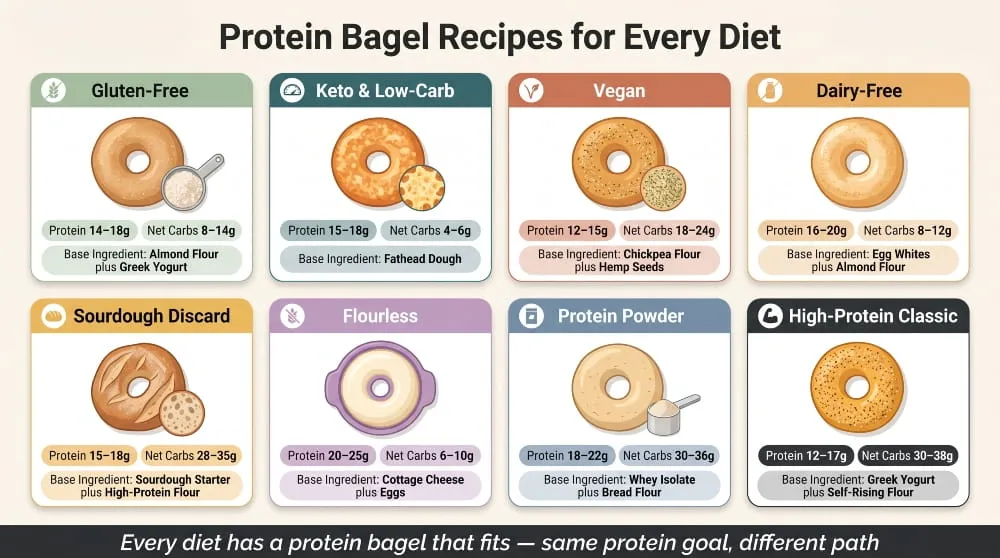
The standard Greek yogurt or cottage cheese protein bagel is excellent, but it doesn’t work for everyone. Whether you’re avoiding gluten, dairy, animal products, or refined carbohydrates, there’s a legitimate high-protein bagel method that fits your dietary framework without asking you to compromise on protein content or settle for a texture that barely resembles a real bagel. Here’s what actually works, and why.
Gluten-Free Protein Bagels (Almond Flour + Oat Flour Methods)
Gluten-free protein bagels are best made with almond flour, oat flour, or a combination of both, and the method you choose significantly affects the texture and protein profile. Almond flour is the higher-protein option, delivering around 6 grams of protein per quarter cup compared to oat flour’s 4 grams, and it produces a denser, slightly richer bagel with a mild nutty flavour. Oat flour yields a lighter crumb that’s closer in texture to a conventional bagel. Still, it’s lower in protein and higher in carbohydrates, making it the better choice for those who are gluten-free by preference rather than necessity.
The most effective gluten-free protein bagel recipe combines almond flour with Greek yogurt or cottage cheese to compensate for the structural role that gluten normally plays. Without gluten to provide elasticity and chew, the yogurt or cottage cheese acts as a binder, helping push the protein content toward 14 to 18 grams per bagel. Xanthan gum is sometimes added in small quantities, typically a quarter teaspoon, to improve the dough’s cohesion and prevent crumbling. These bagels bake well at 375°F for 22 to 25 minutes and hold their shape cleanly once cooled.
For a certified gluten-free result, verify that both your oat flour and baking powder are labelled gluten-free, as cross-contamination during processing is common with standard versions.
Keto and Low-Carb High Protein Bagels
Keto protein bagels address the fundamental tension between traditional bagel dough, which is almost entirely carbohydrate, and a low-carb dietary framework, typically bringing net carbs down to 3-8 grams per bagel while keeping protein at 15 grams or more. The standard keto bagel method uses a fathead dough base: a combination of shredded mozzarella, cream cheese, almond flour, and egg. The mozzarella melts into the almond flour to create a pliable dough that shapes, bakes, and browns like a real bagel while delivering a macro profile that fits cleanly within ketogenic targets.
A standard fathead protein bagel made with two cups of mozzarella, three tablespoons of cream cheese, one and a half cups of almond flour, and two eggs yields approximately 15 to 18 grams of protein and 4 to 6 grams of net carbs per bagel, a dramatic shift from the 45 to 50 grams of carbs in a conventional bagel. The texture is chewier and slightly denser than a traditional bagel, with a mild cheese flavour that works well under savoury toppings and disappears almost entirely under everything bagel seasoning.
For those who want a higher protein count without the cheese-forward flavour, replacing part of the almond flour with a neutral-flavoured whey or egg white protein powder can push protein to 20 grams or more without significantly altering the carb count.
Vegan Protein Bagels (Chickpea, Plant-Based Methods)
Vegan protein bagels are more achievable than most people expect. Still, they require a deliberate ingredient strategy because the two most popular protein bagel methods, Greek yogurt and cottage cheese, are off the table. The most effective plant-based alternative is chickpea-based dough, which uses either canned chickpeas blended to a smooth consistency or chickpea flour as the protein base. Chickpeas deliver around 15 grams of protein per cup and produce a bagel with a satisfying density and mild, neutral flavour that carries toppings well.
A straightforward vegan chickpea protein bagel uses one cup of blended chickpeas, one cup of chickpea flour, a teaspoon of baking powder, and a tablespoon of olive oil to produce a dough that shapes easily and bakes to a firm, sliceable bagel with approximately 12 to 15 grams of protein per serving. For a higher protein count, adding a quarter cup of hemp seeds to the dough contributes an additional 8 to 10 grams of complete plant-based protein. Hemp. Hemp is one of the few plant sources that provides all nine essential amino acids, without significantly changing the texture.
Vegan Greek-style yogurt (coconut or soy-based) can be substituted in standard two-ingredient bagel recipes with reasonable results. However, the protein content will be lower than that of dairy Greek yogurt unless you specifically choose a high-protein soy-based variety, which can deliver 8 to 10 grams of protein per serving compared to 2 to 3 grams in most coconut-based options.
Dairy-Free Protein Bagels
Dairy-free protein bagels are distinct from vegan bagels in that eggs are permitted, which opens up more structural and protein options. The most reliable dairy-free method uses egg whites as both the binder and the primary protein source. A recipe that uses half a cup of liquid egg whites, one cup of almond flour, a teaspoon of baking powder, and a tablespoon of apple cider vinegar produces a firm, protein-dense bagel with 16 to 20 grams of protein and no dairy whatsoever.
Dairy-free Greek-style yogurt can also be used as a direct substitute in standard protein bagel recipes, with the important caveat that soy-based options are substantially higher in protein than almond or coconut-based ones. If you’re dairy-free and using a yogurt substitute, checking the protein content per serving on the label before committing to a batch is worth the 30 seconds; the difference between a 2-gram and a 10-gram protein yogurt alternative can shift your total bagel protein by a third.
Sourdough Discard Protein Bagels
Sourdough discard protein bagels use the unfed starter that accumulates during regular sourdough maintenance as a partial flour replacement, adding flavour complexity, mild tang, and a small protein contribution while reducing waste. A standard sourdough discard protein bagel recipe incorporates half a cup of discard alongside high-protein flour and either Greek yogurt or egg whites to bring the protein content to 14 to 18 grams.
The discard itself contributes modestly to protein, around 3 to 4 grams per half cup depending on the flour used in the starter, but its more significant function is flavour. The lactic and acetic acids produced during fermentation give these bagels a depth that straight Greek yogurt bagels lack, and the resulting crumb is slightly more open and bread-like than the dense two-ingredient versions. These bagels do require a brief rest period, 30 minutes to allow the discard to hydrate the flour fully, but the technique is otherwise no more complex than any other homemade protein bagel method.
For maximum protein, pair sourdough discard with a high-protein bread flour (14%+ protein content) and Greek yogurt rather than water. The combination produces a bagel that’s genuinely competitive with standard protein bagel recipes while carrying the distinctive character of a sourdough ferment.
Flourless Protein Bagels
Flourless protein bagels eliminate wheat flour and build structure from protein-rich whole-food ingredients alone, most commonly eggs, cottage cheese, or a combination of the two. The result is a bagel that’s dramatically higher in protein than any flour-based version, often reaching 20 to 25 grams per serving, while being naturally gluten-free, grain-free, and lower in carbohydrates than even almond flour alternatives.
The most straightforward flourless method blends one cup of cottage cheese with two whole eggs and a teaspoon of baking powder, shapes the mixture using a bagel mould or pipes itpiping it into a ring on a lined baking sheet, and bakes at 375°F for 25 to 30 minutes, until firm and golden. The texture is softer and more egg-forward than a traditional bagel; it won’t have the chew of boiled dough, but it slices cleanly, holds toppings well, and delivers a macro profile that rivals that of a dedicated protein supplement. Adding a tablespoon of psyllium husk to the mixture improves the structure and produces a crumb that’s noticeably closer to a conventional bread texture.
Flourless protein bagels are among the most practical options for anyone following a grain-free, paleo, or high-protein, low-carb diet, and they require no specialty ingredients beyond what’s already in most high-protein kitchens.
Protein Bagels With Protein Powder (When and How to Use It)
Protein powder can be added to bagel dough effectively. Still, it requires a light hand and the right type of powder; otherwise, the result is a dense, rubbery bagel with a chalky aftertaste that no amount of everything seasoning can save. The general rule is to replace no more than a quarter of the total flour with protein powder, keeping the rest of the dough structure intact so the bagel can still develop a proper crumb and crust.
Unflavoured whey isolate is the most forgiving option for bagel baking because it has a neutral flavour, blends smoothly into dough, and doesn’t interfere with the gluten development that gives the bagel its chew. Casein protein is a viable second choice and actually improves moisture retention slightly, producing a less dry result than whey in some formulations. Plant-based protein powders, pea, rice, hemp blends, can work but tend to make doughs denser and slightly grittier; compensating with an extra tablespoon of liquid per quarter cup of plant protein helps manage the texture.
A practical starting point: replace a quarter cup of flour in your standard protein bagel recipe with an equal volume of unflavoured whey isolate, add an extra tablespoon of Greek yogurt or milk to account for the additional absorption, and bake as normal. This addition typically contributes 6 to 8 extra grams of protein per batch, distributed across however many bagels the recipe yields, without noticeably altering the taste or texture when done within these proportions.
Protein Bagel Flavors, Beyond Plain
One of the underrated advantages of homemade protein bagels is that the base dough, whether Greek yogurt, cottage cheese, or almond flour, is neutral enough to carry almost any flavour profile without fighting it. Plain is the default, but it’s far from the ceiling. Every variation below starts with a high-protein foundation and builds flavour on top, so you don’t trade protein for taste. You get both.
Blueberry Protein Bagels
Blueberry protein bagels deliver the sweetness of a classic blueberry bagel with a protein count that a standard bakery version can’t match. The base is a standard Greek yogurt dough, one cup of self-rising flour, one cup of plain Greek yogurt, with half a cup of fresh or frozen blueberries folded in gently just before shaping. Frozen blueberries are the more practical choice for most kitchens: they hold their shape better during mixing, bleed less into the dough, and are available year-round without affecting the recipe’s outcome.
One tablespoon of honey or maple syrup added to the dough enhances the blueberry flavour without pushing the sugar content into dessert territory. A light brush of egg wash before baking gives the exterior a golden finish that contrasts nicely with the purple-blue spots where berries have broken through the surface. Each bagel comes in at approximately 13 to 16 grams of protein, depending on the Greek yogurt brand, making this one of the cleanest high-protein sweet breakfast options available.
Cinnamon Raisin Protein Bagels
Cinnamon raisin protein bagels are the warmest, most comforting entry in the flavour lineup, and they come together with almost no additional complexity beyond the base recipe. To a standard two-ingredient Greek yogurt dough, add 1 teaspoon ground cinnamon, 1 tablespoon brown sugar or coconut sugar, and 1/3 cup raisins. The cinnamon is evenly distributed throughout the dough during mixing, creating a consistent flavour throughout the bagel rather than a topping-only effect.
Soaking the raisins in warm water for ten minutes before folding them into the dough prevents them from drawing moisture out of the bagel during baking, a small step that makes a noticeable difference in the final texture, keeping the crumb from drying out around the fruit. An optional cinnamon-sugar dusting on top before baking creates a lightly caramelized crust that mimics the appeal of a traditional cinnamon-raisin bagel from a bakery. These pair exceptionally well with almond butter or whipped ricotta as a protein-forward spread that complements the sweetness without overwhelming it.
Everything Protein Bagels
Everything protein bagels are arguably the most versatile flavour in the entire category, savoury, deeply aromatic, and compatible with almost any topping from cream cheese to avocado to smoked salmon. The everything bagel seasoning blend does all the flavour work: a standard mix of sesame seeds, poppy seeds, dried garlic, dried onion, and flaky salt applied generously to the exterior of the shaped dough before baking. Most grocery stores carry premixed everything bagel seasoning, which simplifies the process to a single tablespoon pressed onto each bagel before it goes into the oven.
What makes everything protein bagels particularly effective is that the savoury topping completely masks any slight tang or yogurt flavour in the base dough, making this the most crowd-pleasing version for anyone new to homemade protein bagels and unsure whether the texture will win them over. The sesame and poppy seeds in the seasoning also add a small but real protein contribution of their own, around 1 to 2 grams per tablespoon of everything seasoning, and introduce healthy fats that make the bagel more satiating than the plain version.
Garlic Onion Protein Bagels (and Garlic Onion Cheese Version)
Garlic-onion protein bagels occupy a slightly different space from everything bagels: bolder, more savoury, and distinctly punchier in flavour. The standard approach mixes half a teaspoon each of garlic powder and onion powder directly into the dough rather than applying them only to the surface, ensuring the flavour runs through every bite rather than sitting on the crust alone. A tablespoon of dried minced onion folded into the dough adds texture alongside flavour, creating small pockets of intensity throughout the crumb.
The garlic-onion-cheese version builds on this by incorporating half a cup of shredded sharp cheddar into the dough and adding a tablespoon of grated Parmesan to the exterior before baking. The cheese melts into the surface during baking, creating a lightly crisped, golden crust with an almost focaccia-like richness that makes these bagels genuinely impressive straight from the oven. The added cheese pushes the protein count up by 3 to 5 grams per bagel, depending on the quantity used, and the flavour combination, sharp cheddar, garlic, caramelized onion, is strong enough that these bagels need nothing more than a thin layer of butter to function as a complete savoury breakfast or snack.
Cheddar Bay Protein Bagels
Cheddar Bay protein bagels are the viral flavour crossover that borrows everything appealing from the famous Red Lobster biscuit and applies it to a high-protein bagel format. The dough starts with a standard Greek yogurt or cottage cheese base and adds half a cup of shredded cheddar, half a teaspoon of garlic powder, and a quarter teaspoon of Old Bay seasoning, all mixed directly in. The result before baking already smells remarkable.
The defining feature of the Cheddar Bay version is the butter finish: a mixture of 2 tablespoons melted butter, 1/4 teaspoon garlic powder, and a pinch of dried parsley, brushed onto the bagels immediately after they come out of the oven while the surface is still hot. The butter absorbs into the crust rather than sitting on top, producing a rich, glistening exterior that makes these bagels look and taste far more indulgent than a 15-gram protein breakfast has any right to. They’re best eaten within an hour of baking, though a brief 20-second microwave refresh the following day brings them close to fresh.
Pumpkin Protein Bagels
Pumpkin protein bagels are a seasonal flavour that works better than most people expect, primarily because pumpkin puree serves as both a flavour agent and a moisture contributor, improving the texture of the base dough. Replacing two tablespoons of Greek yogurt with an equal amount of canned pumpkin puree, not pumpkin pie filling, which is pre-sweetened, adds a mild earthiness and a distinctly warm colour to the dough without thinning it significantly.
The spice blend is where these bagels earn their character: half a teaspoon of cinnamon, a quarter teaspoon of nutmeg, and a pinch of ginger and clove added directly to the dough. A light brown sugar crust, one tablespoon pressed onto the surface before baking, caramelizes in the oven to produce a slightly sweet, crackled exterior that contrasts cleanly with the spiced crumb. Pumpkin contributes about 1 gram of protein per two tablespoons, a negligible addition on its own. Still, these bagels have the same 13 to 16 grams of protein as the plain version because the yogurt remains the primary protein source. They’re the most autumnal item in the protein bagel repertoire, and they freeze exceptionally well.
Chocolate Chip Protein Bagels
Chocolate chip protein bagels sit at the sweeter, more indulgent end of the spectrum, closer to a breakfast treat than a savoury meal. Still, they deliver enough protein to justify their nutritional value, unlike a muffin or pastry. A tablespoon of cocoa powder added to the base dough creates a subtle chocolate foundation throughout the crumb, and a third of a cup of mini chocolate chips folded in just before shaping ensures even distribution without sinking to the bottom during baking.
Mini chips are specifically worth using here rather than standard-size ones; they distribute more evenly through the smaller volume of protein bagel dough and create a more consistent chocolate presence in every bite. A teaspoon of vanilla extract rounds out the flavour and softens any residual tang from the yogurt base. These bagels pair naturally with almond butter or peanut butter as a spread, which adds another 7 to 8 grams of protein per two-tablespoon serving and creates a flavour combination, chocolate, peanut, and slight yogurt tang, that makes a compelling case for protein bagels as a legitimate dessert-adjacent breakfast option.
Sourdough Protein Bagels
Sourdough protein bagels are the most technically nuanced flavour in the lineup and also among the most rewarding, producing a bagel with genuine depth, a mild tang, and a chew that comes closer to a traditional boiled bagel than almost any other homemade protein method achieves. The sourdough character comes from incorporating active or discard starter into the base dough: half a cup of starter replaces roughly a quarter of the flour, contributing fermentation flavour compounds, primarily lactic and acetic acids, that create complexity no spice or add-in can replicate.
For maximum protein, pair the sourdough starter with high-protein bread flour (14% protein or higher) and Greek yogurt as the liquid, rather than water. This combination produces a dough that handles well, holds its shape during baking, and delivers 15 to 18 grams of protein per bagel with a flavour profile that reads as sophisticated and bakery-quality rather than homemade and improvised. A 30-minute rest after mixing, during which the starter continues to ferment slightly in the dough, deepens the tang noticeably and improves the final crumb structure. These are the protein bagels worth making when you want to impress someone, or when you’ve made the plain version enough times that you’re ready to level up.
How to Build a High-Protein Bagel Meal
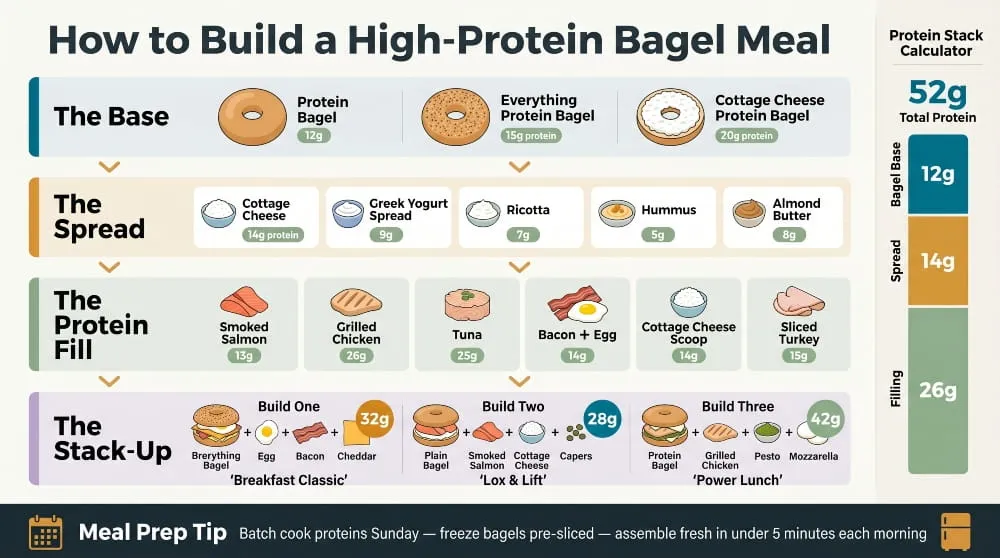
A high-protein bagel is a strong foundation, but the meal you build around it determines whether you’re getting 15 grams of protein or 40. The bagel itself does the structural work; the toppings, fillings, and spreads are where the protein count gets genuinely impressive. Here’s how to build a bagel meal that earns its place in a high-protein diet at every occasion, from breakfast through lunch.
Best High-Protein Bagel Toppings
The most effective high-protein bagel toppings are those that contribute meaningful protein per serving without overwhelming the bagel or requiring significant preparation. Smoked salmon is the highest-impact single topping available; a standard two- to three-ounce serving delivers 10 to 16 grams of protein, pairs naturally with the bagel’s flavour profile regardless of variety, and requires no cooking. Eggs in any form, fried, poached, scrambled, add 6 grams per egg and are the most versatile topping in the category, working equally well on plain, everything, and savoury flavour varieties.
Canned tuna and canned salmon are underused as bagel toppings and offer exceptional protein value: a standard three-and-a-half-ounce can of tuna delivers 25 grams of protein for minimal cost and zero preparation beyond draining. Cottage cheese, as a topping rather than a recipe ingredient, adds 14 grams of protein per half cup and serves as a creamy, spreadable layer that’s meaningfully higher in protein than cream cheese at a fraction of the fat. Hard-boiled egg slices, turkey or chicken breast, sliced avocado paired with eggs, and nut butters round out the topping category, each adding distinct protein contributions that stack cleanly on a high-protein bagel base.
High-Protein Bagel Fillings and Sandwich Ideas
When made into a sandwich, a high-protein bagel becomes one of the most complete portable meals for a high-protein diet. The most reliable high-protein bagel sandwich formula follows a simple architecture: a protein-rich spread on both cut faces, a primary protein filling, a secondary protein or fat source, and vegetables for volume and micronutrient density.
The classic bacon, egg and cheese configuration, two strips of bacon, one or two eggs cooked to preference, and a slice of sharp cheddar, delivers 25 to 30 grams of protein on top of whatever the bagel contributes, producing a complete meal in the 35 to 40 gram range. Turkey and avocado on a protein bagel, with a smear of hummus on one side and mustard on the other, is a lighter but still substantial build, reaching 25 to 30 grams and offering a cleaner ingredient profile. A smoked salmon and cream cheese bagel with capers and red onion is the most elegant option and one of the most protein-complete, delivering 22 to 26 grams in a build that takes under two minutes to assemble.
For a higher-protein lunch sandwich, sliced grilled chicken breast (around 26 grams of protein per 3 ounces), roasted red pepper, spinach, and a tablespoon of pesto on a protein bagel, produces a meal that comfortably clears 40 grams of protein. This is the kind of build that makes a protein bagel genuinely competitive with a dedicated meal prep protein bowl.
High-Protein Spreads for Bagels (Beyond Cream Cheese)
Cream cheese is the default bagel spread, but at 2 grams of protein per two tablespoons, it’s functionally a fat source rather than a protein contributor. Replacing or supplementing it with higher-protein spreads is one of the simplest ways to meaningfully increase the protein content of a bagel meal without changing the format.
Cottage cheese, blended smooth with a pinch of salt and herbs, is the most effective protein spread swap; it spreads like cream cheese, has a similarly mild, creamy flavour, and delivers 14 grams of protein per half cup, versus cream cheese’s 2 grams. Greek yogurt-based spreads, made by combining full-fat Greek yogurt with lemon zest, garlic, and fresh dill, work particularly well on everything or plain protein bagels and add 8 to 10 grams of protein per generous serving. Ricotta, especially part-skim ricotta, delivers around 7 grams of protein per quarter cup and has a delicate sweetness that pairs naturally with blueberry and cinnamon-raisin protein bagels.
Hummus adds 4 to 5 grams of protein per two tablespoons and provides fibre and plant-based fat, making it a genuinely nutritious spread rather than a compromise. Almond butter and peanut butter each contribute 7 to 8 grams per two tablespoons and double as flavour pairings for sweeter protein bagel varieties. Smashed avocado contributes only 1 to 2 grams of protein per serving. Still, it adds healthy monounsaturated fats that improve satiety and nutrient absorption. It’s best used as a base layer under a higher-protein primary spread rather than as the sole topping.
How to Add Even More Protein to a Bagel
When a standard protein bagel with toppings still falls short of a protein target, there are several straightforward ways to boost the count without changing the fundamental meal format. The most impactful single addition is an egg; one whole egg adds 6 grams, two egg whites add 7 grams, with virtually no additional fat, and it integrates naturally into almost any bagel meal configuration.
Adding a second protein layer to a sandwich build, a slice of turkey under the smoked salmon, or a scoop of cottage cheese beneath the avocado, stacks protein efficiently without making the meal feel engineered. Choosing a protein-fortified cream cheese, now widely available from brands like Kite Hill and several store-label lines, swaps the standard spread for one that delivers 5 to 8 grams rather than 2. Sprinkling hemp seeds over any spread or topping adds 10 grams of complete protein per three tablespoons with a mild, nutty flavour that doesn’t compete with the bagel’s other components.
For bagel meal prep contexts where hitting a specific protein number matters, common for athletes, body composition goals, or clinical nutrition targets, pairing a high-protein bagel with a side of Greek yogurt and a hard-boiled egg creates a breakfast combination that consistently reaches 40 to 50 grams of protein with no specialty products and minimal preparation.
High-Protein Bagel Breakfast Meal Prep
High-protein bagel breakfast meal prep works best when the components are prepped separately and assembled fresh each morning, rather than building complete sandwiches in advance and refrigerating them. Assembled bagel sandwiches tend to become soggy within 24 hours as moisture from eggs, vegetables, and spreads migrates into the cut faces of the bagel, a problem that undermines both the texture and the appeal of what should be a satisfying, high-protein start to the day.
The practical approach is to batch-cook the protein components, scrambled eggs, bacon, sausage patties, or grilled chicken, and store them in individual portions in the refrigerator for up to four days. Protein bagels freeze exceptionally well: slice them before freezing, store them in individual zip-lock bags, and toast them directly from frozen in 2 to 3 minutes. Each morning’s assembly takes under five minutes and yields a freshly prepared, high-protein breakfast without the prep time that makes consistent healthy eating difficult to maintain.
For a five-day breakfast prep cycle, a batch of six protein bagels, twelve pre-cooked eggs, ten strips of bacon, and a block of sliced cheddar covers a complete week of high-protein breakfasts in a single Sunday prep session lasting around 45 minutes. Each assembled breakfast delivers 30 to 35 grams of protein, making it one of the most efficient high-protein meal-prep strategies for anyone who needs a fast, portable morning option.
Protein Bagel Lunch Ideas
Protein bagels make a natural transition from breakfast to lunch with minimal adaptation. The base is the same, but the filling philosophy shifts from egg-forward morning builds to more substantial, protein-dense sandwich configurations that carry through an afternoon without triggering energy crashes or hunger rebounds two hours later.
A grilled chicken and pesto protein bagel sandwich, three ounces of sliced chicken breast, a tablespoon of basil pesto, fresh mozzarella, and roasted red pepper, delivers approximately 38 to 42 grams of protein in a format that’s genuinely satisfying and complex enough to not feel like diet food. Tuna salad made with Greek yogurt instead of mayonnaise as the binder, which adds protein while cutting fat, spread generously on a protein bagel, reaches 30 to 35 grams of protein per serving and takes less than five minutes to prepare.
A steak-and-egg protein bagel, made with leftover grilled flank steak sliced thin, a fried egg, arugula, and a smear of horseradish cream, is the most protein-dense lunch build in the category, one of the most flavourful. Flank steak delivers about 23 grams of protein per 3 ounces, bringing the total build to comfortably above 40 grams. For a cold lunch option that travels well, smoked salmon with whipped cottage cheese, cucumber slices, and fresh dill on a plain or everything protein bagel is ready in under three minutes, requires no reheating, and consistently reaches 28 to 32 grams of protein in a format elegant enough to eat at a desk without embarrassment.
Protein Bagel Nutrition Breakdown & Macros
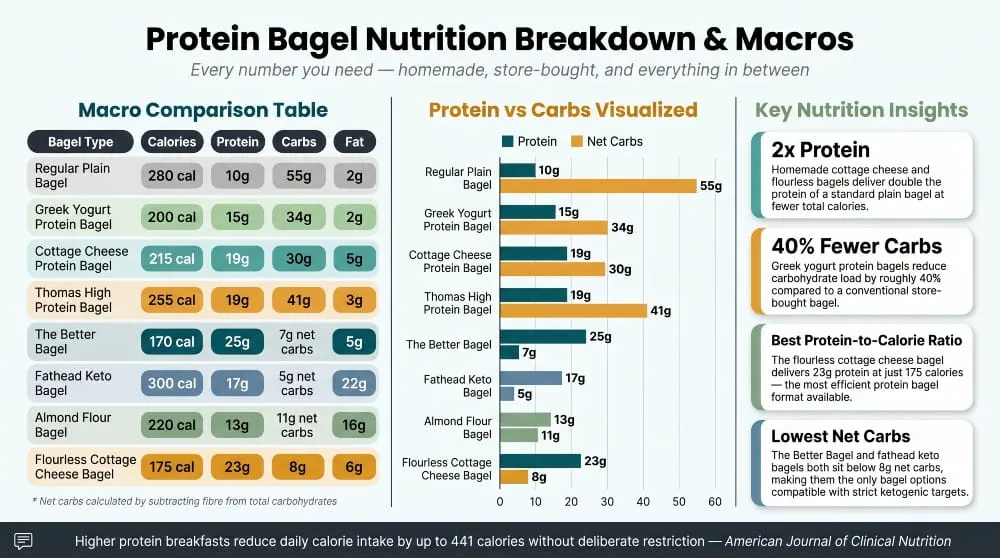
Understanding the full nutritional picture of a protein bagel matters more than the protein number alone. A bagel that delivers 20 grams of protein, 60 grams of carbohydrates, and 400 calories tells a very different story than one that hits the same protein target at half the carbs and two-thirds the calories. Here is the complete macro breakdown across every major protein bagel type, homemade and store-bought, so that you can make decisions based on the full picture rather than a single headline number.
Protein Bagel Macros (Carbs, Fat, Protein, Calories)
Protein bagel macros vary significantly depending on whether the bagel is homemade or commercially produced and on which base ingredients or protein enhancement method were used. The table below covers the most common configurations at a standard single-bagel serving size.
| Bagel Type | Calories | Protein | Carbs | Fat | Notes |
|---|---|---|---|---|---|
| Regular plain bagel | 270–290 | 9–11g | 53–57g | 1–2g | Baseline reference |
| Greek yogurt protein bagel (2-ingredient) | 180–220 | 12–17g | 30–38g | 1–3g | Varies by yogurt brand |
| Cottage cheese protein bagel | 190–230 | 16–20g | 28–35g | 3–6g | Higher protein than Greek yogurt method |
| Thomas’ High Protein bagel | 240–270 | 17–20g | 38–44g | 2–3g | Plant-based protein blend added |
| The Better Bagel | 160–180 | 24–26g | 6–8g net | 4–6g | High fibre, specialty formulation |
| Fathead keto protein bagel | 280–320 | 15–18g | 4–6g net | 20–24g | High fat from mozzarella and almond flour |
| Almond flour protein bagel | 200–240 | 10–14g | 8–14g net | 14–18g | Lower protein than yogurt-based versions |
| Flourless cottage cheese bagel | 160–190 | 20–25g | 6–10g | 5–8g | Grain-free, highest protein density |
All values are approximate and based on standard serving sizes. Net carbs calculated by subtracting fibre from total carbohydrates. Values vary by specific brand and recipe.
The most important pattern in this table is the inverse relationship between carbohydrate content and ingredient complexity. Standard commercial protein bagels reduce carbs modestly while boosting protein with additive blends. Homemade versions using whole-food protein sources, particularly cottage cheese and flourless methods, achieve the most favourable protein-to-carb ratios without specialty ingredients or isolated protein compounds.
Protein Bagel vs. Regular Bagel, Full Comparison
The difference between a protein bagel and a regular bagel is more meaningful than the protein number alone suggests. A standard plain bagel from a grocery store delivers 270 to 290 calories, 9 to 11 grams of protein, 53 to 57 grams of carbohydrates, and virtually no fat. By every macro measure, it is a carbohydrate-dominant food with a modest protein contribution that, on its own, does relatively little to support satiety or muscle protein synthesis.
A well-formulated protein bagel shifts that profile substantially. A homemade cottage cheese protein bagel at roughly 200 calories delivers twice the protein, two-thirds fewer carbohydrates, and a meaningfully different satiety response, not because of any single ingredient, but because protein is the most thermogenic macronutrient, requiring more energy to digest than carbohydrates or fat, and because higher-protein meals consistently reduce subsequent calorie intake compared to carbohydrate-matched alternatives. Research published in the American Journal of Clinical Nutrition found that increasing protein intake from 15% to 30% of total calories led participants to consume 441 fewer calories per day without deliberate restriction, a finding that helps explain why the protein upgrade in a bagel is worth pursuing beyond simple macro arithmetic.
The flavour and texture gap between a regular and a protein bagel has also narrowed considerably. Greek yogurt and cottage cheese bagels, when made correctly, produce a crumb and crust that most people find indistinguishable from a standard bagel; the difference is in the nutrition label, not the eating experience.
Do Egg Bagels Have More Protein Than Plain?
Egg bagels contain marginally more protein than plain bagels, typically 10 to 12 grams versus 9 to 11 grams. Still, the difference is smaller than the name implies and is rarely worth seeking out specifically for protein purposes. Commercial egg bagels incorporate whole eggs or egg yolks into the dough at modest proportions, primarily to enrich the colour and soften the crumb rather than to substantially alter the protein content. A single large egg contributes 6 grams of protein, but when distributed across a batch of eight to twelve bagels, that contribution becomes negligible per bagel.
The practical conclusion is that egg bagels are a minor protein upgrade over plain at best, one to two grams in most cases, and a meaningful protein upgrade only when eggs are added as a topping or filling rather than as a dough ingredient. If the goal is a measurably higher-protein bagel, choosing a purpose-built protein variety or a homemade protein bagel recipe will deliver four to five times the protein improvement that switching from plain to egg achieves.
Are Protein Bagels Good for Weight Loss?
Protein bagels are genuinely well-suited to weight loss for several overlapping reasons, provided they’re chosen thoughtfully rather than simply because the Word “protein” appears on the packaging. The core mechanism is straightforward: protein promotes satiety more effectively than carbohydrates or fat at an equivalent calorie level, meaning a higher-protein breakfast delays the return of hunger and reduces overall calorie intake throughout the day without requiring deliberate restriction or discomfort.
A protein bagel delivering 17 to 20 grams of protein at breakfast, particularly when paired with a high-protein spread like cottage cheese or Greek yogurt, creates a satiety response that a standard bagel at a similar calorie count cannot match. The fibre content of whole wheat or almond flour protein bagels amplifies this effect by slowing gastric emptying and stabilizing blood glucose levels, thereby avoiding the energy spike and subsequent crash that a refined-flour bagel with cream cheese typically produces.
The caveat is calorie density. Some commercial protein bagels achieve their protein content by adding isolated protein blends to standard dough, which means the calorie count remains comparable to a regular bagel at 250 to 290 calories while only modestly improving the macro profile. Homemade protein bagels, particularly cottage cheese or flourless versions, deliver more protein at lower total calories, making them a more efficient weight-loss option. A flourless cottage cheese protein bagel, at 160 to 190 calories with 20 to 25 grams of protein, offers a genuinely exceptional protein-to-calorie ratio that almost no other convenient breakfast food can match.
How Many Carbs Are in a Protein Bagel?
Carbohydrate content in protein bagels ranges widely, from under 8 grams net in specialty low-carb formulations to 44 grams in standard commercial protein bagels that prioritize protein addition over carbohydrate reduction. Understanding which category a given protein bagel falls into is essential for anyone managing carbohydrate intake for metabolic, diabetic, or body composition reasons.
Standard commercial protein bagels like Thomas’ High Protein contain 38 to 44 grams of total carbohydrates, a meaningful reduction from a regular bagel’s 53 to 57 grams, but still a significant carbohydrate load by any low-carb standard. These are appropriate for moderate-carbohydrate diets and general healthy eating, but don’t suit ketogenic or very low-carb frameworks.
Greek yogurt and homemade protein bagels land in the middle range at 30 to 38 grams of carbohydrates, offering a more substantial reduction while maintaining a texture close to that of a traditional bagel. Almond-flour and oat-flour versions drop further to 8-14 grams net, making them compatible with low-carb eating. Specialty commercial products like The Better Bagel use high-fibre formulations that bring net carbs to 6 to 8 grams per bagel, the lowest available in a commercially produced format. However, the texture and ingredient list reflect the significant engineering required to achieve that number. Fathead keto bagels and flourless cottage cheese bagels both have net carbs below 10 grams and are among the most carbohydrate-efficient homemade options without specialty commercial ingredients.
Best High-Protein, Low-Carb Bagel Options Compared
For anyone who needs both high protein and low carbohydrates from a single bagel, athletes in cutting phases, people managing blood sugar, or those following ketogenic or low-carb dietary frameworks, the field narrows to a handful of options that genuinely deliver on both dimensions simultaneously.
| Option | Protein | Net Carbs | Best For |
|---|---|---|---|
| Flourless cottage cheese bagel | 20–25g | 6–10g | Grain-free, highest protein density |
| Fathead keto bagel | 15–18g | 4–6g | Strict keto, lowest net carbs |
| The Better Bagel (commercial) | 24–26g | 6–8g | Convenience, no home baking |
| Almond flour + Greek yogurt bagel | 14–18g | 8–12g | Gluten-free, whole food ingredients |
| Sola protein bagel | 10–12g | 3–5g | Commercial, low-carb, widely available |
| Cottage cheese + almond flour bagel | 16–20g | 6–10g | Best balance of texture and macros |
The flourless cottage cheese bagel and the almond flour plus Greek yogurt combination represent the strongest homemade options across both metrics, high protein and low net carbs achieved through whole food ingredients without specialty formulations or isolated protein compounds. For commercial convenience, The Better Bagel currently leads the category on both protein and net carb performance. However, it comes at a significantly higher price point than standard grocery store alternatives and is available primarily through direct order and select specialty retailers.
The practical recommendation for most people is to make the homemade cottage cheese or almond flour version when time permits and keep a commercial low-carb option, Sola, The Better Bagel, or a keto-formulated alternative, available for days when preparation isn’t realistic. The two-track approach maintains both the macro profile and the consistency that effective dietary strategies require.
Storage, Freezing & Practical Tips
Knowing how to make a great protein bagel is only half the equation; knowing how to store them properly determines whether batch two tastes as good as batch one. Homemade protein bagels behave differently from commercial bagels in storage because their ingredient profile is fundamentally different: higher moisture content from Greek yogurt or cottage cheese, lower preservative load, and a denser crumb that responds to humidity in ways a standard grocery store bagel doesn’t. Get the storage right, and a single batch covers a full week of high-protein breakfasts without a noticeable drop in quality.
How to Store Homemade Protein Bagels
Homemade protein bagels store best at room temperature for 24 to 48 hours, then in the refrigerator or freezer. For same-day or next-day consumption, allow the bagels to cool completely on a wire rack before storing. Sealing warm bagels traps steam inside the container, which accelerates mould growth and turns the crust from firm to soft and slightly gummy within hours.
Once fully cooled, store at room temperature in an airtight container or zip-lock bag with as much air removed as possible. A paper bag inside a zip-lock bag is the most effective room-temperature method: the paper absorbs excess surface moisture while the outer bag prevents the bagel from drying out. Avoid storing homemade protein bagels on the counter unwrapped; the higher moisture content from yogurt or cottage cheese causes them to stale and develop surface mould significantly faster than a conventional flour-and-water bagel would under the same conditions.
For anything beyond 48 hours, refrigeration or freezing is the right call. Protein bagels refrigerate well without significant quality loss, which is an advantage over traditional bagels. The higher protein content and lower starch concentration mean they don’t undergo retrograde starch crystallization, which makes standard bagels turn unpleasantly hard and dry in the fridge overnight.
Can You Freeze Protein Bagels? (And How to Do It Right)
Protein bagels freeze exceptionally well, better, in most cases, than their conventional counterparts, making batch cooking the most practical approach to incorporating them consistently into a weekly meal routine. The key to successful freezing is slicing before freezing rather than after: a pre-sliced frozen protein bagel can go directly from the freezer into a toaster or toaster oven in two to three minutes, producing a result that’s virtually indistinguishable from fresh. An unsliced frozen bagel requires thawing before slicing, adding 20 to 30 minutes to the morning routine and creating a window for uneven texture as the exterior thaws faster than the dense interior.
The correct freezing method is straightforward. Once the bagels have cooled completely, do not freeze them while they are still warm. Slice each one through the equator, wrap individually in plastic wrap or place in individual zip-lock bags, and transfer to a larger freezer bag or an airtight container. Individual wrapping before the outer bag prevents the bagels from fusing into a frozen block that requires defrosting the entire batch to access a single bagel. Properly wrapped protein bagels maintain full quality in the freezer for up to three months, with only marginal texture changes beyond that window.
Avoid freezing assembled bagel sandwiches. Cream cheese, cottage cheese, and egg-based fillings do not freeze well; the water content separates on thawing, resulting in a wet, unappetizing product. Freeze the bagels alone and assemble fresh each morning using pre-cooked protein components stored separately in the refrigerator.
Do Protein Bagels Need to Be Refrigerated?
Homemade protein bagels do not strictly require refrigeration within the first 24 to 48 hours, but they benefit from it significantly beyond that point. The yogurt or cottage cheese used in most protein bagel recipes introduces a level of moisture and dairy content that makes room-temperature storage riskier than for a standard flour-based bagel. At room temperature, homemade protein bagels are best for 1 day and acceptable for 2; after 48 hours without refrigeration, the risk of surface mould increases noticeably, particularly in warm or humid climates.
Store-bought commercial protein bagels, Thomas’, Sola, The Better Bagel, and similar brands, follow the storage guidance printed on their packaging, which typically allows for room temperature storage until the best-by date, owing to the preservatives and modified atmosphere packaging used in commercial production. Once opened, commercial protein bagels benefit from the same airtight storage principles as homemade versions and should be consumed within three to five days or frozen for longer-term storage.
The practical rule is simple: if you’ll eat it today or tomorrow, room temperature in an airtight container is fine. If you won’t, refrigerate or freeze it immediately rather than waiting to see how it goes.
How Long Do Protein Bagels Last?
The shelf life of a protein bagel depends on the storage method, the ingredients used, and whether it’s homemade or commercially produced. Homemade protein bagels made with Greek yogurt or cottage cheese last 1 to 2 days at room temperature, 4 to 5 days in the refrigerator, and up to 3 months in the freezer without significant quality degradation. Commercial protein bagels last considerably longer at room temperature, typically seven to fourteen days unopened, owing to preservatives and sealed packaging, but follow the same refrigeration and freezing guidelines as homemade versions once the package is opened.
Among homemade variations, flourless cottage cheese bagels tend to have the shortest room-temperature shelf life because of their higher moisture content and egg-based structure, which makes them more perishable than flour-based versions. Almond-flour protein bagels sit in the middle range, lasting comfortably for 2 days at room temperature before the texture begins to deteriorate. Greek yogurt bagels made with self-rising flour are the most stable of the homemade options at room temperature, owing to their lower overall moisture content and closer resemblance to a conventional bread structure.
In all cases, visual inspection is the most reliable indicator of freshness. Any sign of surface mould, an off smell, or a significantly wet or slimy texture on the crust is a signal to discard rather than toast and hope for the best.
How Long to Bake Protein Bagels
Most homemade protein bagels bake at 375°F to 400°F (190°C to 205°C) for 20 to 28 minutes, depending on the base ingredient, bagel size, and whether the oven runs hot or cool. The Greek yogurt two-ingredient method, the most common homemade approach, bakes optimally at 375°F for 22 to 25 minutes, producing a golden-brown exterior and a fully set, dry interior crumb that doesn’t collapse when sliced.
Cottage cheese protein bagels require slightly longer at the same temperature, 25 to 28 minutes, because of the higher moisture content in cottage cheese relative to strained Greek yogurt. Underbaking cottage cheese bagels is the most common failure point in that recipe: an underbaked cottage cheese bagel will appear set on the surface but remain wet and slightly doughy in the centre, collapsing when sliced or toasted. The internal temperature test is the most reliable method for confirming doneness. A fully baked protein bagel should read 190°F to 200°F (88°C to 93°C) at the centre on an instant-read thermometer, the same target used for fully baked bread.
Almond flour and keto fathead bagels bake faster than yogurt-based versions, typically 18 to 22 minutes at 400°F, and brown more aggressively on the exterior owing to the fat content of the almond flour and cheese. Monitoring the colour rather than relying solely on a timer is the better approach for these varieties: the target is a deep golden brown across the entire surface, not just the top. A loose foil tent placed over the bagels for the final five minutes prevents over-browning on the exterior while the centre finishes baking through.
An egg wash, one beaten egg brushed lightly over the surface before baking, consistently improves both colour and crust formation across every protein bagel variety and takes under a minute to apply. It is the single most impactful finishing step in homemade protein bagel baking and the one most often skipped in recipe shortcuts.
Frequently Asked Questions (FAQ’s)
Are protein bagels actually healthy?
Yes, protein bagels made with whole-food ingredients like Greek yogurt, cottage cheese, or almond flour are a genuinely nutritious choice, delivering twice the protein of a standard bagel with fewer refined carbohydrates and no significant downside for most people. The caveat applies to heavily processed commercial versions that use isolated protein blends and additives to hit their numbers; whole-food homemade versions are unambiguously the cleaner option.
How much protein is in a bagel with cream cheese?
A standard plain bagel with two tablespoons of cream cheese delivers approximately 12 to 14 grams of protein; the bagel contributes 9 to 11 grams, and the cream cheese adds roughly 2 grams. Swapping regular cream cheese for cottage cheese or a protein-fortified spread can push that total to 20 grams or more without changing the meal’s format.
Do egg bagels have more protein than plain bagels?
Egg bagels contain marginally more protein than plain bagels, typically 10 to 12 grams versus 9 to 11. Still, the difference amounts to one to two grams at most, because eggs are incorporated into commercial doughs in small proportions for colour and texture rather than protein content. If more protein is the goal, choosing a purpose-built protein bagel delivers four to five times the improvement as switching to an egg bagel.
What is the highest protein bagel you can buy?
The Better Bagel currently leads the commercial category, delivering 24 to 26 grams of protein per bagel at 6 to 8 grams of net carbs through a high-fibre specialty formulation. Thomas’ High Protein bagels are the most widely available option at 17 to 20 grams, found in most major grocery chains, the better choice for accessibility, The Better Bagel for maximum protein output.
Are protein bagels good for weight loss?
Protein bagels support weight loss effectively because protein is the most satiating macronutrient. Research shows that higher-protein breakfasts reduce total daily calorie intake without deliberate restriction. A homemade cottage cheese or flourless protein bagel at 160 to 190 calories with 20 to 25 grams of protein delivers an exceptional protein-to-calorie ratio, making it one of the most efficient weight-loss breakfast options available.
Do protein bagels need to be refrigerated?
Homemade protein bagels don’t require refrigeration within the first 24 to 48 hours if stored in an airtight container at room temperature. Still, they should be refrigerated or frozen beyond that point due to their dairy-based ingredients. Commercial protein bagels follow their printed best-by guidance until opened, after which the same 48-hour room-temperature rule applies.
Can I make protein bagels without Greek yogurt?
Yes, cottage cheese is the most effective substitute, delivering equal or higher protein than Greek yogurt and producing a slightly denser, richer bagel with a clean flavour. Dairy-free alternatives include blended silken tofu, high-protein soy-based yogurt, or a chickpea-based dough for a fully plant-based version that still reaches 12 to 15 grams of protein per bagel.
What is the easiest protein bagel recipe?
The two-ingredient Greek yogurt bagel is the simplest method: combine one cup of self-rising flour with one cup of plain Greek yogurt, mix into a dough, shape into rings, apply everything bagel seasoning, and bake at 375°F for 22 to 25 minutes. No boiling, no yeast, no proofing time, the entire process from bowl to oven takes under ten minutes and produces a bagel with 12 to 17 grams of protein.
How much protein do 2-ingredient bagels have?
Two-ingredient protein bagels made with self-rising flour and Greek yogurt typically deliver 12 to 17 grams of protein per bagel, depending primarily on the Greek yogurt brand used. Choosing a Greek yogurt with 15 to 17 grams of protein per serving, brands like Fage, Chobani, or Siggi’s consistently produce bagels at the higher end of that range without changing any other part of the recipe.
Where does the protein in bagels come from?
In a conventional bagel, all protein comes from wheat flour, specifically the glutenin and gliadin proteins that form gluten, present at roughly 12 to 14 grams per 100 grams of bread flour. In high-protein bagels, additional protein sources are layered on top of that base: Greek yogurt and cottage cheese contribute casein and whey protein, almond flour adds plant-based protein, and commercial brands incorporate isolated protein blends, whey, pea, or soy, directly into the dough formulation.