A standard plain bagel contains roughly 270–300 calories, 55–58 grams of carbohydrates, 10–11 grams of protein, and 1–2 grams of fat, making it one of the more calorie-dense breakfast breads, but also one of the most satisfying.
That number shifts significantly depending on flavor, size, toppings, and whether you’re eating a supermarket bagel or a fresh-baked one. A mini bagel clocks in around 100 calories. A large deli-style everything bagel with cream cheese can push past 500. Knowing exactly what’s in your bagel, and why it varies, is what this guide is for.
Bagels have a bit of a complicated reputation in nutrition circles. They’re often lumped in with “bad carbs,” yet a well-made bagel from quality ingredients delivers real protein, meaningful iron and B vitamins, and enough staying power to carry you through a full morning. Context matters enormously here, and the numbers tell a more nuanced story than most people expect.
Whether you’re tracking macros, managing your carb intake, comparing bagels to other breakfast options, or simply curious about what you’re eating, this breakdown covers every variety, every common topping combination, and every size so that you can make an informed choice every time.
Why “bagel nutrition” isn’t one number
The USDA reference figure for a plain bagel is based on a 105g serving, roughly a medium-sized bagel. But walk into any authentic NYC-style bagel shop, and the bagel in your hand is likely 130–150g, which changes every number on that label. Packaged bagels, meanwhile, are often smaller and more uniform. Fresh-baked bagels made with high-quality flour, water, and minimal additives tend to have a cleaner ingredient profile even when the macros look similar on paper. The source of your bagel matters as much as the size.
A note on this guide: all nutritional figures referenced below are based on USDA FoodData Central values and standard industry averages. Specific products and fresh-baked items will vary; always check the source when precision matters.
What’s Actually in a Bagel? The Complete Nutrition Overview
A bagel is primarily a carbohydrate food, but that’s only part of the story. Beyond the carbs, a standard bagel delivers a meaningful amount of protein, trace amounts of fat, and a surprisingly solid micronutrient profile that often gets overlooked in casual nutrition conversations.
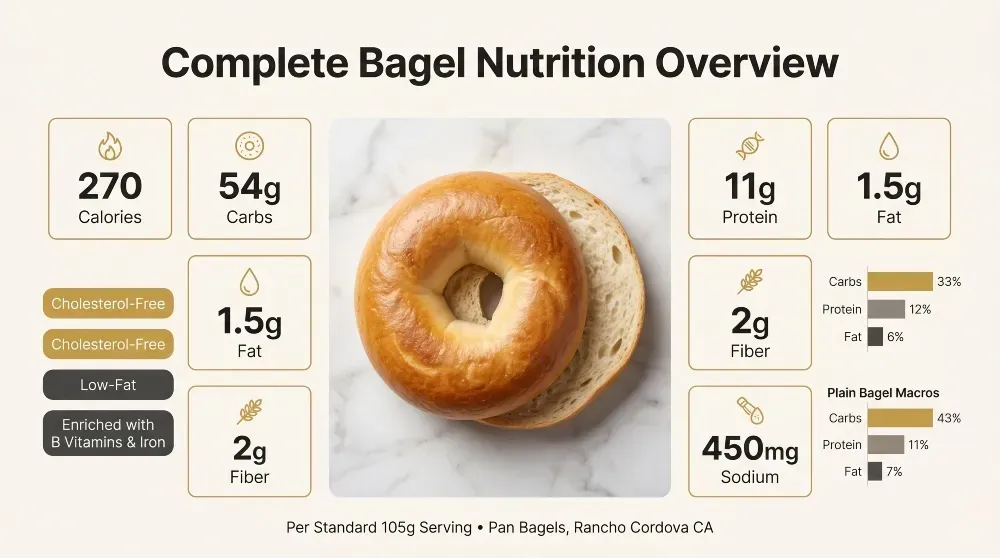
Macronutrients at a Glance: Calories, Carbs, Protein & Fat
A medium plain bagel (approximately 105g) contains around 270 calories, 53–58g of carbohydrates, 10–11g of protein, and just 1–2g of fat. That macronutrient split, heavy on carbs, moderate on protein, very low in fat, is what defines the bagel as a food. It’s a high-carbohydrate, low-fat source of sustained energy, not unlike a dense slice of artisan bread, but more compact and calorie-efficient by volume.
The carbohydrate count is the figure most people focus on, and understandably so. At roughly 53–58g per medium bagel, you’re looking at the carbohydrate equivalent of three to four slices of standard sandwich bread. That’s not inherently a problem; carbohydrates are the body’s preferred fuel source, but it’s a meaningful number for anyone managing blood sugar, following a lower-carb eating pattern, or tracking daily intake.
Protein is where bagels quietly punch above their weight. 10 to 11 grams per bagel is a respectable contribution for a bread product, largely due to the gluten development that occurs during the boiling-and-baking process that defines a proper bagel. For comparison, two eggs deliver about 12 grams of protein, meaning a bagel alone gets you most of the way there before you’ve added a single topping.
Fat content is minimal in a plain bagel, typically under 2 grams, so nearly all the calories come from carbohydrates and protein. Add cream cheese, and that number changes quickly. A standard two-tablespoon schmear contributes roughly 100 calories and 10g of fat on its own.
Micronutrients: Vitamins, Minerals & Fiber Content
Bagels made from enriched flour, which covers the majority of commercially produced and widely fresh-baked varieties, contain added B vitamins, including thiamine (B1), riboflavin (B2), niacin (B3), and folic acid, as well as iron. These aren’t naturally present in refined white flour; they’re added back after milling as a standard enrichment practice and contribute meaningfully to daily nutritional targets.
A medium plain bagel provides approximately 15–20% of the daily recommended intake of iron and 20–25% of several B vitamins, depending on the brand and formulation. Folic acid content is particularly notable; enriched bagels can deliver 15–20% of the daily folate target in a single serving, which matters for a population where folate intake is frequently below recommended levels.
Fiber is the honest weak point of a traditional white flour bagel. A plain bagel contains only 1–2 grams of dietary fiber, which is modest against the recommended daily intake of 25–38 grams. This is precisely where whole wheat, whole grain, and multigrain varieties start to earn their reputation; a whole wheat bagel of the same size typically delivers 3–5 grams of fiber, a meaningful improvement that also moderates the glycemic response. Sodium is another number worth watching: a standard bagel contains 400–500mg of sodium before any toppings, representing roughly 17–22% of the daily recommended limit.
How Bagel Size Affects Nutritional Value (Mini vs. Standard vs. Large)
Bagel size is the single biggest variable in bagel nutrition, and it catches people off guard more than almost any other factor. The USDA standard for a “medium” bagel is 105 grams. Still, that figure doesn’t reflect what you’ll actually encounter across different buying contexts, and the calorie difference between a mini and a large bagel isn’t small.
A mini bagel, typically around 40–45 grams, comes in at roughly 100–110 calories with about 20g of carbohydrates and 4g of protein. These are the bite-sized versions found in grocery store bags or served as part of a brunch spread. At the other end of the spectrum, a large deli-style bagel, the kind you’d get at an authentic NYC-style bagel shop, often weighs 130–150 grams or more, putting it in the 350–420 calorie range with 65–75g of carbohydrates. That’s nearly four times the calorie content of a mini, from the same food.
The practical implication is that comparing nutritional labels across bagel products without accounting for serving weight is essentially meaningless. A packaged grocery bagel listed at 260 calories and a fresh-baked shop bagel that “looks similar” may differ by 100–150 calories simply because of mass. If nutritional precision matters to you, weighing your bagel, rather than relying on generic database entries, gives you a far more accurate picture. A kitchen scale and a USDA baseline figure will serve you better than any app’s auto-populated entry.
Plain Bagel Nutrition Facts
A plain bagel is the nutritional baseline against which every other variety is measured. At a standard 105g serving, it delivers a clean, unflavored profile that makes it the most useful reference point in bagel nutrition, and one of the most searched.
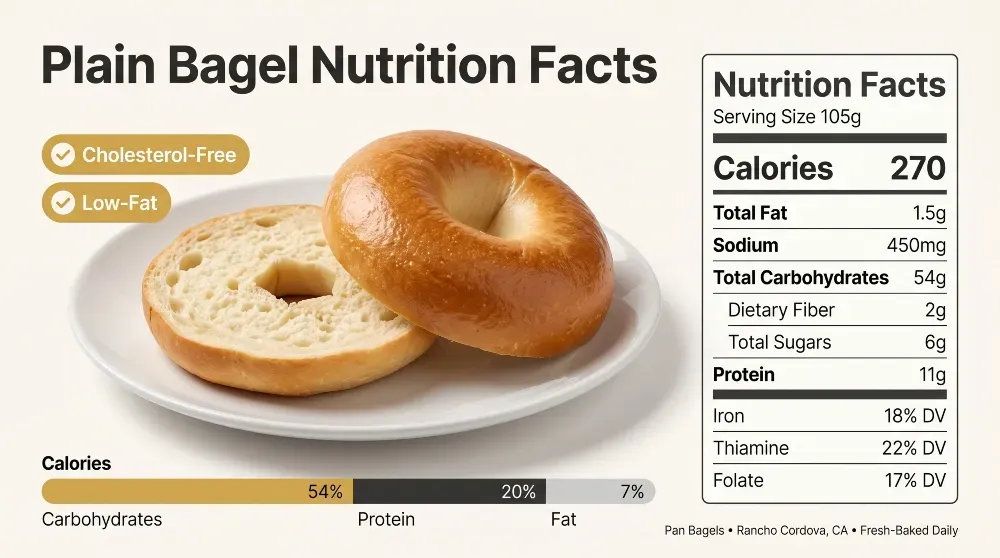
Plain Bagel Calories & Macros (Standard 105g Serving)
A plain bagel at the standard 105g serving size contains approximately 270–280 calories. The macronutrient breakdown is straightforward: roughly 53–56g of carbohydrates, 10–11g of protein, 1–2g of fat, and 1–2g of dietary fiber. Sodium sits at around 430–500mg, which is worth noting given that it accounts for nearly a fifth of the recommended daily limit before a single topping has been added.
The calorie count feels moderate in isolation, but context matters. That 270–280 calories comes almost entirely from carbohydrates, with protein as the secondary contributor and fat barely registering. For a breakfast food eaten plain, it’s a lean profile. For most people, though, a plain bagel is a vehicle for cream cheese, butter, eggs, or smoked salmon, and those additions are where the total meal nutrition shifts substantially.
What makes the plain bagel nutritionally significant, beyond its macros, is its glycemic load. White flour bagels digest relatively quickly, leading to a faster rise in blood glucose than slower-digesting carbohydrate sources. This is neither catastrophic nor irrelevant; it simply means that pairing a plain bagel with a protein or fat source isn’t just a flavor choice; it’s a practical way to slow digestion and extend satiety. A plain bagel with two tablespoons of cream cheese, for instance, shifts the meal’s glycemic response meaningfully while adding only about 100 calories.
Plain Bagel Nutrition Label Breakdown
Reading a plain bagel nutrition label requires knowing what to look for and what the numbers actually mean in the context of a whole diet. Here is what a standard enriched white flour plain bagel label typically shows per 105g serving:
Calories: 270–280
Total Fat: 1.5g (Saturated Fat 0.2g, Trans Fat 0g)
Cholesterol: 0mg
Sodium: 430–500mg
Total Carbohydrates: 53–56g (Dietary Fiber 1–2g, Total Sugars 5–7g)
Protein: 10–11g
Iron: 15–20% DV
Thiamine (B1): 20–25% DV
Niacin (B3): 20% DV
Folate: 15–20% DV
Calcium: 4–6% DV
The sugar figure, 5–7 grams, surprises some people. Still, it’s largely a byproduct of the malt or honey often used in traditional bagel recipes to feed the yeast and contribute to the characteristic crust. It isn’t added sugar in the way a pastry contains added sugar; it’s a functional ingredient with a minimal net impact on the overall nutritional profile.
The iron and B vitamin figures are where the enrichment story becomes relevant. These nutrients were removed during milling and added back by law in the United States, making enriched bagels a genuine contributor to daily micronutrient intake, not just empty calories, as they’re sometimes characterized.
Nutritional Difference: White vs. Whole Wheat Plain Bagel
The nutritional difference between a white plain bagel and a whole wheat plain bagel is real, but more nuanced than the marketing around whole wheat products typically suggests. At the same 105g serving size, the calorie counts are nearly identical; whole wheat bagels come in at 240–270 calories, only marginally lower than their white counterparts. The fat and protein figures are similarly close. Where the gap opens up meaningfully is in fiber and micronutrient density.
A whole-wheat plain bagel typically delivers 3–5 grams of dietary fiber, compared to 1–2 grams in a white bagel. That difference may sound minor, but fiber has an outsized effect on satiety, blood sugar modulation, and digestive health relative to its caloric contribution. According to research published in the American Journal of Clinical Nutrition, higher dietary fiber intake is consistently associated with lower body weight and reduced risk of type 2 diabetes, making that extra 2–3 grams per bagel a meaningful daily habit rather than a trivial distinction.
Whole wheat bagels also retain more naturally occurring vitamins and minerals, magnesium, zinc, and additional B vitamins that are present in the wheat bran and germ, which are removed in the milling of white flour. Enrichment restores some of what’s lost in white flour, but not all of it, and the form in which nutrients occur naturally in whole grain is generally better absorbed.
The practical trade-off is texture and taste. Whole wheat bagels are denser, slightly earthier, and less airy than a well-made white bagel. For many people, that’s an acceptable exchange for the nutritional upgrade. For others, particularly those who care about the specific character of a traditional NYC-style bagel, the white-flour version isn’t a compromise; it’s the point. Both are valid choices. Knowing the difference lets you make the one that fits your goals.
Nutrition Facts by Bagel Flavor
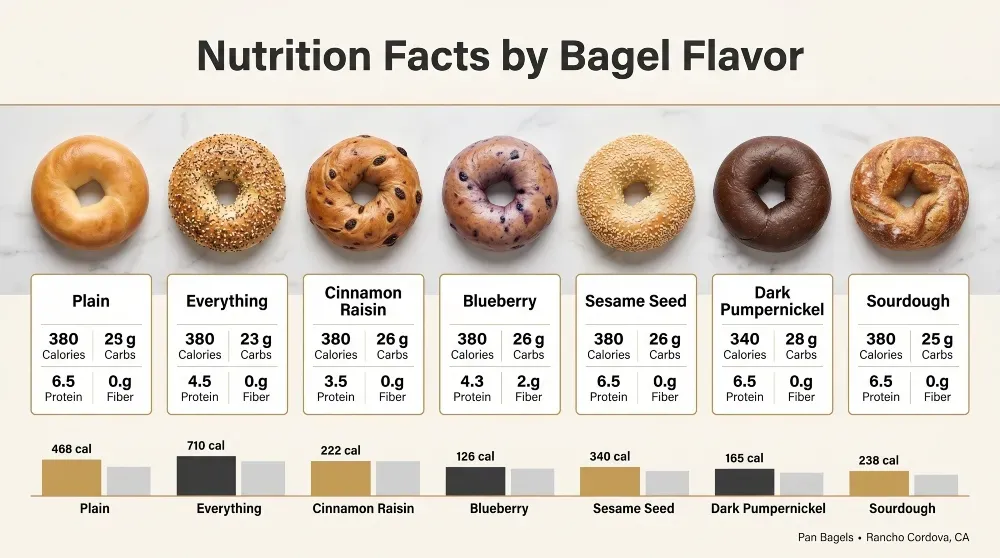
Bagel flavor affects nutrition more than most people expect, not just in calories, but in sugar, sodium, fat, and fiber content. The base dough is largely consistent across varieties, but the ingredients that define each flavor introduce real nutritional differences worth understanding.
Everything Bagel Nutrition Facts
An everything bagel at a standard 105g serving contains approximately 270–290 calories, 52–55g of carbohydrates, 10–11g of protein, 2–3g of fat, and 2g of fiber. The slight uptick in fat and sodium compared to a plain bagel comes directly from the topping blend: sesame seeds, poppy seeds, dried garlic, dried onion, and coarse salt, each contributing in small but cumulative amounts.
Sodium is the figure that deserves the most attention here. Where a plain bagel sits at around 430–500mg, an everything bagel can reach 550–620mg, occasionally higher depending on how generously the salt topping is applied. That’s a meaningful difference if you’re actively managing sodium. The seeds, on the other hand, contribute a small but genuine dose of healthy fats; sesame and poppy seeds both contain unsaturated fatty acids, making the everything bagel marginally more nutritionally complex than its plain counterpart despite the similar calorie count.
Cinnamon Raisin Bagel Nutrition Facts
A cinnamon raisin bagel is the sweetest of the mainstream bagel varieties, and the nutrition reflects that. At a standard serving, expect approximately 270–290 calories, 57–61g of carbohydrates, 8–10g of protein, 1–2g of fat, and 2g of fiber. The carbohydrate count is noticeably higher than a plain bagel, driven by the natural sugars in the raisins and the added sugar in the cinnamon swirl; total sugars typically land between 10–14g per bagel, compared to 5–7g in a plain variety.
That sugar profile matters in two ways. First, it means the cinnamon raisin bagel digests slightly faster and produces a quicker glycemic response than a plainer variety. Second, it makes this the one bagel flavor where the topping choice is particularly consequential; pairing it with cream cheese or butter adds fat that slows that sugar absorption, whereas eating it plain amplifies the rapid-carb effect. It’s also worth noting that the slightly lower protein content, typically 1–2g less than a plain bagel, is a result of the raisins and cinnamon partially displacing flour in the dough formula.
Blueberry Bagel Nutrition Facts
Blueberry bagel nutrition is similar to cinnamon raisin in its elevated sugar profile, with a standard serving delivering roughly 270–285 calories, 55–59g of carbohydrates, 9–10g of protein, 1–2g of fat, and 1–2g of fiber. Total sugars typically fall in the 8–12g range, again driven by the fruit content, whether real blueberries or blueberry-flavored pieces; both add sugar that a plain or savory bagel doesn’t carry.
What separates blueberry from cinnamon raisin nutritionally is largely the absence of the cinnamon-sugar swirl, which keeps the sugar ceiling slightly lower in most formulations. Real blueberries also contribute trace amounts of antioxidants, anthocyanins, specifically, though the quantity per bagel is too small to represent a meaningful dietary source. The blueberry bagel is best understood as a mildly sweet carbohydrate food with a pleasant flavor profile, not a fruit-forward nutrition vehicle.
Sesame, Onion, Poppy Seed & Asiago Bagel Nutrition
These four flavors represent the savory end of the bagel spectrum, and as a group they stay nutritionally close to the plain bagel baseline, with a few notable exceptions.
Sesame and poppy seed bagels land at approximately 270–285 calories per standard serving, with fat content slightly elevated (2–3g) due to the naturally occurring oil in both seed types. The effect is minor in absolute terms, but these two are among the marginally more nutrient-dense topping varieties, as both sesame and poppy seeds contribute small amounts of calcium, iron, and unsaturated fats.
Onion bagels are nearly identical to plain in macronutrient terms, same calorie range, same carbohydrate count, with a touch more sodium from the dried onion seasoning. The flavor difference is entirely about the topping, not the dough composition.
Asiago bagels are the notable outlier in this group. The cheese baked into and onto an asiago bagel adds meaningful fat and calories, typically pushing the total to 300–320 calories, with 4–6g of fat and an additional 1–2g of protein from the dairy. Sodium is also elevated, often reaching 600mg or above. For a savory bagel with a richer nutritional profile, Asiago is the one flavor that genuinely diverges from the plain baseline rather than simply approximating it.
Pumpernickel, Rye & Sourdough Bagel Nutrition
These three varieties share a common characteristic: they’re made with alternative or mixed flours that meaningfully alter the nutritional profile compared to standard enriched white-flour bagels.
Pumpernickel bagels, made with dark rye flour and typically molasses, deliver approximately 240–260 calories per standard serving, with 47–52g of carbohydrates, 8–9g of protein, 1g of fat, and 3–4g of fiber. The fiber content is the standout figure, making pumpernickel one of the higher-fiber options in the bagel category without requiring a “whole wheat” label. The molasses also contributes small amounts of iron, potassium, and calcium.
Rye bagels follow a similar pattern: slightly lower in calories than white flour bagels, higher in fiber, and with a denser texture that reflects rye’s slower fermentability relative to wheat. A standard rye bagel typically contains 250–270 calories, 50–54g of carbohydrates, and 3–4g of fiber. Rye’s particular advantage is its relatively lower glycemic index compared to white wheat flour, attributed to its arabinoxylan fiber content, which slows gastric emptying.
Sourdough bagels are the most nutritionally variable of the three because the defining characteristic, long fermentation, is a process, not an ingredient. A sourdough bagel made with white flour will have a macronutrient profile close to a plain white bagel (270–285 calories, 53–56g carbs, 10g protein). Still, the fermentation process partially breaks down phytic acid, thereby improving mineral absorption. Some research suggests fermented bread products may also have a modestly lower glycemic impact than their non-fermented equivalents, though the evidence in bagel-specific contexts remains limited.
French Toast, Pretzel & Specialty Flavor Nutrition
Specialty flavors occupy their own nutritional category; they’re where the bagel formula departs most significantly from the plain baseline, and the numbers reflect that.
French toast bagels, popularized by brands like Costco’s in-house bakery variety, typically contain 290–320 calories per serving, with 58–64g of carbohydrates and 10–13g of total sugars. The flavor comes from added cinnamon, vanilla, and sugar worked into the dough, making this one of the sweeter bagel options outside of dessert-adjacent varieties. Fat content remains low at 1–2g, but the sugar load is closer to that of a lightly sweetened pastry than to a traditional bagel.
Pretzel bagels, a hybrid of the soft pretzel and the bagel, typically finished with coarse salt after a lye or baking soda bath, come in at approximately 280–300 calories with a noticeably higher sodium count, often 600–700mg or above, driven by the salt crust and the alkaline baking process that creates the characteristic chew and color. Protein and carbohydrate figures are close to a plain bagel; the sodium is the variable that sets them apart.
Pumpkin, jalapeño cheddar, chocolate chip, and other limited-run specialty flavors vary too widely by producer to generalize precisely. Still, as a category, they tend to be calorie-equivalent or slightly higher than plain bagels, with elevated sugar (sweet varieties) or sodium and fat (cheese or savory varieties). When in doubt with a specialty flavor, the specific producer’s nutrition information is the only reliable reference.
Bagel Nutrition Comparison by Flavor
| Flavor | Calories | Carbs (g) | Protein (g) | Fat (g) | Fiber (g) |
|---|---|---|---|---|---|
| Plain | 270–280 | 53–56 | 10–11 | 1–2 | 1–2 |
| Everything | 270–290 | 52–55 | 10–11 | 2–3 | 2 |
| Cinnamon Raisin | 270–290 | 57–61 | 8–10 | 1–2 | 2 |
| Blueberry | 270–285 | 55–59 | 9–10 | 1–2 | 1–2 |
| Sesame | 275–290 | 53–56 | 10–11 | 2–3 | 2 |
| Onion | 265–280 | 53–56 | 10–11 | 1–2 | 1–2 |
| Poppy Seed | 270–285 | 53–56 | 10–11 | 2–3 | 2 |
| Asiago | 300–320 | 52–55 | 11–13 | 4–6 | 1–2 |
| Pumpernickel | 240–260 | 47–52 | 8–9 | 1 | 3–4 |
| Rye | 250–270 | 50–54 | 9–10 | 1 | 3–4 |
| Sourdough | 270–285 | 53–56 | 10–11 | 1–2 | 1–2 |
| French Toast | 290–320 | 58–64 | 9–10 | 1–2 | 1–2 |
| Pretzel | 280–300 | 54–58 | 10–11 | 1–2 | 1–2 |
All values based on a standard 105g serving. Fresh-baked and branded products will vary; use this table as a directional reference, not a substitute for producer-specific nutrition data.
Bagel With Toppings: Nutrition Facts for Popular Combinations
A plain bagel is rarely eaten plain. The nutritional reality of how most people actually consume a bagel, with cream cheese, eggs, smoked salmon, or a breakfast sandwich build, looks significantly different from the base bagel numbers alone. Toppings can add anywhere from 50 to 400 calories depending on what you choose and how much you use, which makes understanding the full combination essential for accurate nutritional tracking.
Bagel With Cream Cheese Nutrition (Plain, Everything, Cinnamon Raisin)
A plain bagel with cream cheese is one of the most commonly searched-for food-nutrition combinations in the United States. For good reason; it’s the default preparation for millions of bagel eaters every morning. The standard two-tablespoon schmear of regular cream cheese adds approximately 100 calories, 9–10g of fat, 1–2g of carbohydrates, and 2g of protein to whatever bagel it’s applied to. That brings a plain bagel with cream cheese to roughly 370–380 calories total, with 55–58g of carbohydrates and 12–13g of protein.
The cream cheese addition does something nutritionally useful beyond just adding flavor: the fat content slows gastric emptying, which moderates the glycemic response of the bagel itself. A plain bagel eaten alone digests relatively quickly; the same bagel with a full schmear of cream cheese delivers a meaningfully more sustained energy release.
Flavor variations shift the numbers modestly. An everything bagel with cream cheese lands at approximately 375–395 calories, with slightly elevated sodium from both the seasoning topping and the cream cheese. A cinnamon raisin bagel with cream cheese comes in at 375–390 calories but carries a higher sugar load, typically 12–15g total, which makes it the sweetest of the three combinations and the one that reads most like a breakfast treat rather than a neutral morning meal. Light cream cheese roughly halves the fat content (about 5g fat per two tablespoons) for those managing fat intake without wanting to abandon the combination entirely.
Bagel With Butter Nutrition Facts
A bagel with butter is a simpler nutritional combination, but the calorie addition is comparable to that of cream cheese, and the nutritional trade-off is less favorable. A standard tablespoon of butter adds 100 calories and 11–12g of fat, almost entirely saturated fat, at approximately 7g per tablespoon. Most people apply closer to 1.5–2 tablespoons to a full bagel, which pushes the fat addition to 150–200 calories and 15–22g of saturated fat before the bagel itself is counted.
A plain bagel with one tablespoon of butter totals approximately 370–380 calories, 53–56g of carbohydrates, 10–11g of protein, and 12–14g of fat, of which the majority is saturated. The American Heart Association recommends keeping saturated fat to under 13g per day for a standard 2,000-calorie diet, meaning a buttered bagel can account for a significant portion of that ceiling in a single meal. That’s not a reason to avoid it, but it’s worth knowing if cardiovascular health is a consideration. For a pure calorie-for-calorie comparison, butter and standard cream cheese are roughly equivalent; the meaningful differences lie in the fat composition and the absence of protein in butter.
Bagel With Peanut Butter Nutrition
A bagel with peanut butter is the topping combination that most substantially changes the meal’s nutritional character, and largely for the better. Two tablespoons of standard peanut butter add approximately 190 calories, 16g of fat (mostly unsaturated), 7–8g of protein, 6g of carbohydrates, and 2g of fiber to the base bagel. The result is a nutritionally dense combination that delivers around 460–470 calories, 59–62g of carbohydrates, 17–19g of protein, and 17–18g of fat.
That protein-and-fat combination makes a peanut butter bagel one of the most satiating bagel preparations available, the kind of breakfast that genuinely competes with a full cooked meal in terms of staying power. The unsaturated fat profile of peanut butter is also meaningfully different from butter or cream cheese, contributing to heart health rather than working against it. The carbohydrate count is higher than in a cream cheese preparation because of the natural carbohydrates in peanut butter. Still, the fiber addition and slower fat digestion offset much of that from a blood sugar management perspective. This combination works particularly well on a whole-wheat or whole-grain bagel, where the fiber contributions compound.
Lox Bagel Nutrition Facts
A lox bagel, the classic combination of a bagel, cream cheese, and smoked salmon, often finished with capers, red onion, and tomato, is one of the most nutritionally complete bagel preparations you can build. A standard assembly using a plain bagel, two tablespoons of cream cheese, and two ounces of smoked salmon totals approximately 430–460 calories, 55–58g of carbohydrates, 22–26g of protein, and 12–15g of fat.
The smoked salmon component is what elevates this combination nutritionally. Two ounces of lox contributes approximately 13–14g of high-quality protein and 3–4g of fat, predominantly omega-3 fatty acids. The American Heart Association specifically recommends eating fatty fish like salmon at least twice per week for cardiovascular health, and a lox bagel makes that recommendation genuinely convenient. The trade-off is sodium: smoked salmon is a cured product, and 2 ounces typically add 600–900mg of sodium on top of what’s already in the bagel and cream cheese. Total sodium for a fully assembled lox bagel can reach 1,200–1,500mg, which is worth factoring in for anyone managing hypertension or sodium-sensitive conditions. The garnishes- capers, onion, tomato- add negligible calories but meaningful flavor and trace micronutrients.
Egg & Cheese Bagel Nutrition
An egg and cheese bagel is a straightforward breakfast sandwich that balances carbohydrates with a solid protein and fat foundation. A standard preparation, one plain bagel, one large fried or scrambled egg, and one slice of American or cheddar cheese, totals approximately 420–460 calories, 53–57g of carbohydrates, 20–24g of protein, and 12–16g of fat.
The egg contributes roughly 70–90 calories, 6–7g of protein, and 5–6g of fat depending on preparation method. A fried egg adds slightly more fat if cooked in butter or oil; a scrambled egg prepared dry is closer to the lower end. The cheese slice adds 60–110 calories and 4–9g of fat, depending on the variety; American cheese is on the lower end of that range, sharp cheddar on the higher end. What this combination delivers that a cream cheese bagel doesn’t is a significantly higher protein count, which makes the egg and cheese bagel a notably more satiating morning meal for those prioritizing protein intake. At 20–24g of protein, this preparation rivals many dedicated high-protein breakfast products.
Bacon, Egg & Cheese Bagel Nutrition Facts
Adding bacon to an egg and cheese bagel is one of the most popular breakfast sandwich upgrades, and the nutritional impact is predictable but significant. Two strips of cooked bacon contribute approximately 80–90 calories, 6–8g of fat, and 5–6g of protein, along with a substantial sodium addition of 350–400mg per two strips. A bacon, egg, and cheese bagel assembled with a standard plain bagel, two eggs, one cheese slice, and two bacon strips totals approximately 550–620 calories, 53–58g of carbohydrates, 28–34g of protein, and 20–26g of fat.
The protein content at this build level, approaching 30g or above, is genuinely impressive for a single breakfast item and explains much of the staying power that a proper bacon, egg, and cheese bagel provides. The sodium figure, however, demands attention: a fully assembled sandwich can reach 1,100–1,400mg of sodium, representing roughly half the daily recommended limit in a single meal. For most healthy adults, eating an otherwise low-sodium diet is manageable. For those with cardiovascular concerns or sodium sensitivity, it’s a figure worth tracking actively.
Sausage, Egg & Cheese Bagel Nutrition
A sausage, egg, and cheese bagel is the highest-calorie of the mainstream breakfast bagel sandwich builds, and the sausage is why. A standard pork breakfast sausage patty (approximately 50g) contributes 170–200 calories, 14–17g of fat, 9–10g of protein, and 350–450mg of sodium. Combined with a plain bagel, one egg, and one cheese slice, the total for a sausage, egg, and cheese bagel lands at approximately 600–680 calories, 53–58g of carbohydrates, 27–32g of protein, and 26–34g of fat.
The fat content is where this build separates itself from the bacon version; sausage contains significantly more fat per gram than bacon, particularly saturated fat. A full sausage, egg, and cheese bagel can deliver 8–12g of saturated fat, which represents a substantial portion of the daily recommended ceiling. The protein delivery is comparable to the bacon version, making the meaningful question for most people one of fat preference rather than protein outcome. Turkey or chicken sausage alternatives reduce calorie and fat content by approximately 30–40% while maintaining a similar protein contribution, making them a straightforward swap for those wanting the format with a lighter nutritional profile.
Cottage Cheese Bagel Nutrition
The cottage cheese bagel has emerged as a high-protein alternative to cream cheese in recent years, and its nutritional case is strong. Half a cup of standard full-fat cottage cheese adds approximately 110–120 calories, 12–14g of protein, 5g of fat, and 4–5g of carbohydrates. The same volume of regular cream cheese delivers comparable calories but only 4–5g of protein, making cottage cheese roughly three times more protein-efficient as a bagel topping at similar calorie cost.
A plain bagel with half a cup of cottage cheese totals approximately 380–400 calories, 57–61g of carbohydrates, 22–25g of protein, and 6–8g of fat. That protein figure, approaching 25g from a simple two-ingredient preparation, makes it one of the highest-protein standard bagel combinations available without adding meat. The texture and flavor profile are milder than those of cream cheese, making it particularly well-suited to savory preparations with added toppings like everything bagel seasoning, sliced cucumber, or fresh herbs. For anyone building a higher-protein breakfast around a bagel without a full sandwich, cottage cheese is one of the most nutritionally efficient options.
Whole Wheat & Healthier Bagel Options: Nutrition Comparison
Not all bagels are nutritionally equal, and the flour used to make them is the single biggest determinant of that difference. Whole wheat, whole grain, multigrain, sprouted, and fermented bagel varieties each offer a meaningfully different nutritional profile from standard white flour bagels, with fiber, micronutrient density, and glycemic impact as the primary variables that set them apart.
Whole Wheat Bagel Nutrition Facts
A whole wheat bagel at a standard 105g serving delivers approximately 240–270 calories, 47–52g of carbohydrates, 10–11g of protein, 1.5–2g of fat, and 3–5g of dietary fiber. The calorie count is only marginally lower than that of a white-flour bagel; the real nutritional advantage lies in the fiber content, which typically runs 2 to 3 times higher than that of the plain white equivalent.
That fiber increase comes directly from the bran and germ retained in whole wheat flour, both of which are stripped out during the refining process that produces white flour. Beyond fiber, whole wheat bagels naturally contain higher levels of magnesium, zinc, phosphorus, and vitamin E, nutrients present in wheat germ that don’t survive milling in white flour and aren’t fully restored by enrichment. Manganese is particularly notable: a whole wheat bagel can provide 60–80% of the daily recommended intake of this trace mineral, which plays a role in bone health, blood sugar regulation, and antioxidant function.
The trade-off between taste and texture is real. Whole wheat bagels are denser and earthier than white flour bagels, with a chewier crumb and a less glossy exterior than a traditional boiled-and-baked white bagel. For many people, that’s an acceptable exchange; for purists who care about the specific texture of a classic NYC-style bagel, it’s a meaningful departure. Both are legitimate positions; the nutritional difference simply gives you a clearer basis for the choice.
Whole Grain vs. White Bagel: Which Is Healthier?
The honest answer is that whole grain bagels are nutritionally superior to white bagels in several measurable ways. Still, the practical health impact depends heavily on the rest of your diet and what you’re actually comparing.
On the numbers, whole-grain bagels clearly win on fiber (3–5g vs. 1–2g), naturally occurring micronutrients, and glycemic impact. The fiber difference alone has significant downstream effects: a 2022 analysis in The Lancet found that people consuming the highest amounts of dietary fiber had a 15–30% lower risk of cardiovascular disease, type 2 diabetes, and colorectal cancer than those consuming the least. That’s a population-level finding, not a per-bagel guarantee. Still, it illustrates why the fiber gap between whole grain and white bagels is more consequential than the modest calorie difference suggests.
Where the comparison gets more nuanced is in the “whole grain” label itself. A bagel labeled whole grain or whole wheat must contain whole grain flour as a primary ingredient in the United States, but it doesn’t have to be made exclusively from whole grain flour. Many commercial whole wheat bagels blend whole wheat and enriched white flour, which softens the texture and improves shelf life but also reduces the fiber and micronutrient advantage. Reading the ingredient list and confirming that “whole wheat flour” or “whole grain flour” appears first is the only reliable way to verify that you’re getting the full nutritional benefit rather than a mostly white-flour product with a marketing upgrade.
White bagels made from quality enriched flour are not nutritionally empty. The enrichment process restores meaningful amounts of B vitamins and iron, and a white bagel paired with high-protein, high-fiber toppings can deliver a nutritionally comparable meal to a whole wheat bagel eaten plain. Whole grain wins in isolation; context determines whether that advantage is meaningful in practice.
12-Grain & Multigrain Bagel Nutrition
Multigrain and 12-grain bagels occupy an interesting middle ground nutritionally; they often look more impressive on the label than they perform in the actual numbers. A standard multigrain bagel contains approximately 250–280 calories, 48–54g of carbohydrates, 9–11g of protein, 2–3g of fat, and 3–5g of fiber. The fiber and fat figures are slightly higher than white bagels and comparable to whole wheat, largely due to the seeds and grains incorporated into the dough or pressed onto the surface.
The critical distinction with multigrain products is between grains added as inclusions versus grains used as the primary flour. A bagel studded with oats, millet, flaxseed, and sunflower seeds on a white-flour base is technically multigrain. It offers some nutritional benefits from those additions, but it’s fundamentally different from one made with whole-grain flour as the foundation. The seed and grain inclusions contribute healthy fats (particularly from flax and sunflower seeds), additional fiber, and trace minerals, but in quantities that are meaningful rather than transformative relative to the white flour baseline.
Where multigrain bagels genuinely shine is in variety of nutrition: the combination of different grains and seeds tends to deliver a broader micronutrient profile than any single-grain product, even if no individual nutrient is dramatically higher. Flaxseeds contribute omega-3 fatty acids. Oats add beta-glucan, a soluble fiber with well-documented cholesterol-lowering properties. Sunflower seeds bring vitamin E and selenium. The aggregate effect of a true multigrain bagel made with quality ingredients is a more nutritionally diverse product than its calorie count alone suggests.
Ezekiel Bagel Nutrition Facts
Ezekiel bagels, produced by Food for Life and formulated with sprouted grains, represent a genuinely distinct nutritional category within the bagel market. A standard Ezekiel bagel (approximately 85g, slightly smaller than a conventional bagel) delivers around 200–210 calories, 40–42g of carbohydrates, 9–10g of protein, 0.5–1g of fat, and 5–6g of fiber. The lower calorie count relative to conventional bagels is partly a function of size and partly of the ingredient composition.
The sprouted-grain formula, which combines sprouted wheat, barley, millet, lentils, soybeans, and spelt, sets Ezekiel apart from both white and whole-wheat bagels. Sprouting partially breaks down the starch in grains before baking, reducing the glycemic impact of the finished product and increasing the bioavailability of several nutrients. The combination of grains and legumes also produces a more complete amino acid profile than wheat-only products, meaning the protein in an Ezekiel bagel is higher quality in terms of essential amino acid coverage than the equivalent grams of protein from a white flour bagel.
Ezekiel bagels are also made without added sugar and without preservatives, which matters to some consumers and affects both shelf life and flavor. They’re typically sold frozen for this reason. The taste and texture are distinctly different from a conventional bagel, denser, heartier, and less chewy, which makes them a product you choose for nutritional reasons more than for the classic bagel experience. For those prioritizing fiber, lower glycemic impact, and ingredient quality above all else, Ezekiel bagels are the most nutritionally optimized mainstream option in the category.
Sourdough Bagel Nutrition: Is Fermentation a Factor?
Sourdough bagels have the same macronutrient profile as conventional white flour bagels on paper, approximately 270–285 calories, 53–57g of carbohydrates, 10–11g of protein, and 1–2g of fat per standard serving. The flour hasn’t changed. The fermentation, however, changes what happens to those carbohydrates during digestion in ways that matter nutritionally even when the label looks identical.
The long fermentation process used in true sourdough production, whether for bread or bagels, allows naturally occurring bacteria to partially break down phytic acid, an antinutrient found in grains that binds to minerals like iron, zinc, and magnesium, reducing their absorption. Lower phytic acid means better mineral bioavailability from the same gram-for-gram nutrient content, a genuine nutritional advantage that doesn’t appear on a standard nutrition label. Research published in the Journal of Agricultural and Food Chemistry has demonstrated that sourdough fermentation can reduce phytic acid content by up to 90% compared to conventionally leavened bread, substantially improving the bioavailability of key minerals.
Glycemic impact is the other fermentation factor worth understanding. Several studies have found that sourdough bread produces a lower postprandial blood glucose response than equivalent non-fermented products made from the same flour, an effect attributed to the organic acids produced during fermentation, which slow starch digestion. The evidence for bagels specifically is less direct than for sourdough bread given the boiling step in bagel production. Still, the principle applies to the portion of fermentation byproducts that survive the baking process.
The practical caveat is that “sourdough bagel” is not a protected or regulated term. A bagel labeled sourdough may have undergone a full traditional long fermentation or may simply have sourdough flavoring added to a conventionally leavened dough. True sourdough bagels from a bakery made with a live starter and proper fermentation time offer the nutritional benefits described above. Sourdough-flavored bagels from a commercial production line do not. When the fermentation advantage matters to you, the source and process matter as much as the label.
Low-Carb, Keto & Gluten-Free Bagel Nutrition
Alternative bagels, keto, low-carb, gluten-free, and high-protein varieties exist to preserve the bagel format for people whose dietary needs conflict with a traditional white flour product. The nutritional profiles of these alternatives vary dramatically from each other and from conventional bagels, and understanding those differences is essential before assuming any “healthier” bagel label delivers what it promises.
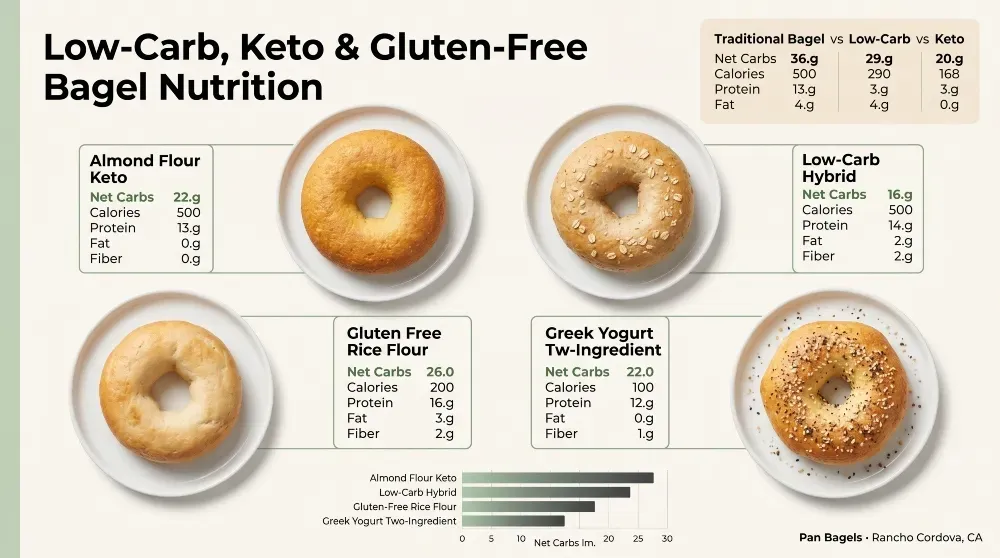
Keto Bagel Nutrition Facts: What to Expect
A keto bagel is engineered to deliver the bagel experience with a fraction of the net carbohydrates of a conventional product. Most commercially available keto bagels contain between 3–8g of net carbohydrates per serving, compared to 53–58g in a standard plain bagel, achieved primarily through the substitution of wheat flour with almond flour, coconut flour, or a combination of both, alongside high-fiber ingredients that reduce the net carb count after fiber subtraction.
The macronutrient profile of a typical keto bagel differs fundamentally from that of a conventional one. A standard keto bagel (approximately 70–85g) delivers roughly 180–230 calories, 10–18g of total carbohydrates, 8–15g of fiber (resulting in 3–8g net carbs), 8–12g of protein, and 10–16g of fat. That fat content, five to eight times higher than a plain white bagel, reflects the fat-dense nature of almond and coconut flour, which is the primary mechanism by which keto baked goods achieve their macronutrient targets.
The texture gap between a keto bagel and a traditional bagel is significant and worth naming directly. Almond flour lacks gluten, which means keto bagels cannot replicate the characteristic chew and density of a boiled wheat bagel. The result is a product that occupies the same shape and general function as a bagel while being a categorically different eating experience. For someone following a strict ketogenic diet where carbohydrate restriction is non-negotiable, that trade-off is straightforward. For someone simply looking for a “lighter” bagel, the high fat content means keto bagels are not automatically lower in calories; many are comparable to, or even higher than, conventional bagels in total calorie terms.
Low-Carb Bagel Nutrition Compared to Traditional Bagels
Low-carb bagels occupy the middle ground between conventional bagels and strict keto products; they reduce carbohydrate content meaningfully without targeting the near-zero net carb counts of ketogenic formulations. Most low-carb bagels contain between 15–30g of net carbohydrates per serving, achieved through partial flour substitution, added fiber ingredients, or both. That’s a 40–70% reduction from the conventional bagel baseline, which is significant for carb-conscious consumers without requiring the full dietary architecture of a ketogenic approach.
The calorie range for low-carb bagels is typically 180–260 calories per serving, often slightly lower than a conventional bagel because refined flour is replaced with fiber-rich ingredients that add bulk without the same caloric density. Protein content varies depending on formulation; products using wheat protein isolate or added whey can deliver 12–18g of protein per bagel, noticeably higher than a conventional product. Fat content lands between conventional and keto bagels, typically 4–9g, again depending on the flour alternatives used.
The ingredient list is where low-carb bagels diverge most visibly from traditional ones. Modified wheat starch, oat fiber, inulin, wheat gluten, and chicory root fiber are common additions that reduce net carbs while maintaining a more bread-like texture than almond flour alternatives. These ingredients are generally well tolerated by most people, except inulin and chicory root fiber, which can cause digestive discomfort, gas, and bloating in individuals sensitive to fermentable fibers (FODMAPs). For people with irritable bowel syndrome or similar conditions, checking the ingredient list of low-carb bagels before committing to regular consumption is advisable.
Gluten-Free Bagel Nutrition Facts
A gluten-free bagel serves a specific and genuine dietary need for people with celiac disease or non-celiac gluten sensitivity. Still, it’s worth being clear upfront that gluten-free does not mean lower in carbohydrates, calories, or sugar. Most gluten-free bagels are made from rice flour, tapioca starch, potato starch, or a proprietary blend of gluten-free flours, and these alternatives tend to be nutritionally similar to, or in some cases less nutritious than, refined white wheat flour.
A standard gluten-free bagel (approximately 90–105g) contains roughly 230–270 calories, 48–58g of carbohydrates, 2–4g of protein, 2–5g of fat, and 1–3g of fiber. The protein figure is where the most significant nutritional gap appears; gluten-free flours lack the gluten protein that gives conventional bagels their 10–11g protein contribution, and most gluten-free formulations don’t compensate for this through alternative protein sources. For the approximately 1% of the population with celiac disease, for whom gluten consumption triggers an autoimmune response that damages the small intestine, this nutritional trade-off is entirely appropriate and necessary. For people without a clinical reason to avoid gluten, choosing gluten-free bagels for perceived health benefits isn’t supported by the nutritional data.
The texture of gluten-free bagels has improved substantially over the past decade as manufacturers have refined their flour blends and production methods. Still, the fundamental absence of gluten means they lack the elasticity and chew that define a traditional bagel. Toasting helps significantly; gluten-free bagels tend to perform considerably better toasted than at room temperature, where the starch-based structure can become gummy or dense.
Greek Yogurt & Cottage Cheese Bagels: Higher Protein Options
Greek yogurt bagels and cottage cheese bagels represent a different category of alternative entirely, not reduced-carb products, but high-protein reformulations that use dairy as a primary ingredient to dramatically increase the protein content of a standard bagel. Both have gained significant mainstream traction in recent years, driven largely by the viral popularity of two-ingredient dough recipes on social media.
A Greek yogurt bagel made with self-rising flour and full-fat Greek yogurt (the classic two-ingredient ratio) delivers approximately 180–220 calories, 30–36g of carbohydrates, 12–16g of protein, and 1–3g of fat per bagel. The protein content, 40–60% higher than a conventional bagel at comparable or lower calorie counts, comes from the high protein density of Greek yogurt, which contributes roughly 17g of protein per 170g serving. This makes Greek yogurt bagels one of the most protein-efficient homemade bagel options available without specialty ingredients.
Cottage cheese bagels follow a similar principle, with slightly different nutritional outcomes. Using blended cottage cheese in place of or alongside Greek yogurt produces a bagel with comparable protein content, typically 13–17g per bagel, along with slightly higher fat and a softer, more tender crumb than the Greek yogurt version. The macronutrient profile varies meaningfully depending on the fat content of the cottage cheese used: full-fat versions contribute more calories and fat; low-fat versions reduce both while maintaining the protein advantage. Both varieties work best when eaten fresh or lightly toasted and don’t hold up as well as conventional bagels over time, given the absence of the commercial preservatives and production techniques that extend shelf life.
2-Ingredient Bagel Nutrition Facts
The two-ingredient bagel, made from self-rising flour and Greek yogurt in roughly equal parts by weight, became one of the most-shared homemade recipes of the past five years, and the nutritional case for it is genuinely compelling. A standard two-ingredient bagel made with approximately 120g self-rising flour and 120g full-fat Greek yogurt yields four bagels, each containing roughly 180–210 calories, 30–34g of carbohydrates, 12–15g of protein, 1–3g of fat, and 1–2g of fiber.
Compared to a conventional plain bagel, the two-ingredient version delivers approximately 60–80 fewer calories, 20–25 fewer grams of carbohydrates, and 2–5 additional grams of protein, a meaningful nutritional improvement across every major macro without requiring specialty ingredients, a ketogenic diet, or a significant departure from the bagel format. The texture is the most notable limitation: two-ingredient bagels are softer and less chewy than boiled-and-baked conventional bagels, with a biscuit-adjacent crumb that satisfies the bagel-shaped-vessel need without replicating the classic experience.
For home cooks, the two-ingredient formula is also highly adaptable. Substituting whole wheat self-rising flour increases fiber to 3–4g per bagel. Adding everything bagel seasoning on top before baking adds negligible calories with significant flavor payoff. Using non-fat Greek yogurt shaves another 20–30 calories and 1–2g of fat. The base formula is a starting point, not a fixed recipe, and across all its variations, it consistently outperforms a conventional packaged bagel on protein efficiency and calorie density.
Bagel Size & Format: How Portions Change the Numbers
Bagel size is the most underestimated variable in bagel nutrition, often more consequential than flavor choice, topping selection, or flour type. The same basic bagel formula produces a 100-calorie mini and a 420-calorie large deli bagel, which means portion awareness matters more here than with almost any other bread product.
Mini Bagel Nutrition Facts
A mini bagel weighing approximately 40–45g contains roughly 100–120 calories, 20–23g of carbohydrates, 4–5g of protein, and less than 1g of fat. Fiber content is minimal at 0.5–1g, and sodium sits at around 180–220mg, proportionally consistent with a full-sized bagel scaled down by weight.
Mini bagels serve a specific nutritional function that their full-sized counterparts can’t easily replicate: portion control without sacrifice. For someone who wants the flavor and format of a bagel without the full carbohydrate load, a mini bagel with toppings can deliver a satisfying breakfast or snack at 200–250 total calories, roughly half the calorie cost of a standard bagel preparation. They also work well as a platform for high-protein toppings where the topping-to-bagel ratio is part of the nutritional strategy. Two mini bagels with cottage cheese and smoked salmon, for instance, deliver a balanced macro profile at a controlled calorie count that a single large bagel with the same toppings couldn’t match for portioning flexibility.
The nutritional limitations of mini bagels are simply the flip side of their convenience: the small surface area and low weight mean toppings quickly dominate the nutritional profile, and the temptation to eat multiple minis often erases the portion advantage. Three mini bagels consumed casually exceed the calorie count of a single standard bagel, a pattern worth noting when they’re available in a bag of 12.
Bagel Thins & Skinny Bagel Nutrition Facts
Bagel thins, thin-sliced, lower-calorie bagels popularized by brands like Thomas’, are not smaller bagels. They’re full-diameter bagels produced with significantly less dough, creating a product designed specifically to deliver the surface area for toppings at a dramatically reduced calorie count. A standard bagel thin (approximately 50–55g) contains roughly 110–130 calories, 24–27g of carbohydrates, 4–6g of protein, 0.5–1g of fat, and 2–3g of fiber.
The fiber content is proportionally higher in many bagel thin products than in standard bagels, a result of manufacturers incorporating whole wheat flour or added fiber ingredients into the formula to improve the nutritional profile of what, by design, is a reduced-portion product. That combination of lower calories and higher relative fiber makes bagel thins one of the more nutritionally efficient bagel formats for people managing calorie intake without abandoning the bagel format entirely.
The honest trade-off is textural. A bagel thin has very little crumb; it’s essentially two thin crusts with minimal interior, which produces a different eating experience than a full bagel. Toasted, they perform well and hold toppings effectively. Untoasted, the structural thinness can make them feel insubstantial. Whether that’s a meaningful limitation depends entirely on what you’re using them for: as a platform for a loaded breakfast sandwich, bagel thins work well; as a standalone snack, they leave most people unsatisfied, unlike a mini bagel would.
Scooped-Out Bagel Nutrition: Does It Help?
Scooping, removing the interior dough from a bagel to create a hollow shell, is a longstanding deli practice that genuinely does reduce the calorie and carbohydrate content of a bagel, but by less than most people assume. Removing the interior dough of a standard plain bagel typically removes approximately 25–50g of dough, reducing the calorie count by roughly 50–100 calories and carbohydrates by 10–20g. A scooped plain bagel therefore contains approximately 170–230 calories and 33–45g of carbohydrates, depending on how aggressively it’s scooped and what size bagel it started as.
The practical nutritional benefit is real but comes with a meaningful caveat: scooping creates more interior surface area, which typically results in more topping being applied to fill the space. A scooped bagel with an extra-generous cream cheese application to fill the cavity can easily cancel the calorie reduction from scooping before you’ve finished the schmear. The technique works as a calorie-reduction strategy only when the topping quantity is held constant, which, in practice, requires conscious portion control of the filling rather than an intuitive spread.
There’s also a textural argument against scooping that intersects with nutrition. The dough interior of a properly made bagel contributes not just calories but protein and some B vitamins from the enriched flour; removing it eliminates a small but genuine nutritional contribution alongside the carbohydrates. For a conventional white bagel where minimizing carbs is the goal, scooping is a reasonable tool. For a whole-wheat or multigrain bagel where the interior crumb contributes fiber and micronutrients, the trade-off is less straightforward.
Half a Bagel Nutrition Facts
Eating half a bagel is the most intuitive portion-reduction strategy available and, nutritionally, the most precise; there’s no ambiguity about how much dough has been removed. Half of a standard 105g plain bagel contains approximately 135–140 calories, 26–28g of carbohydrates, 5–6g of protein, and less than 1g of fat. Half of a large 140g deli bagel sits at approximately 175–200 calories and 32–37g of carbohydrates.
The half-bagel format works particularly well as part of a balanced breakfast where other protein and fiber sources are already present. Half a plain bagel alongside two scrambled eggs and sliced avocado, for instance, delivers a nutritionally complete meal at around 400 calories, with a macro balance of protein, healthy fat, and complex carbohydrates that a full bagel preparation rarely achieves without intentional construction. The half-bagel is also the most practical format for people who want a genuine bagel experience, not a thin, not a mini, not a scooped shell, at a controlled carbohydrate count.
The one nutritional consideration specific to the half-bagel format is what happens to the other half. Research on food availability and consumption consistently shows that leaving a second half accessible increases the likelihood of consuming it, a behavioral pattern sometimes called the “unit bias,” where the presence of a remaining portion creates implicit pressure to finish it. Wrapping and refrigerating the second half immediately, rather than leaving it on the counter, is a small behavioral intervention with a meaningful practical effect on actual consumption.
Large Bagel Nutrition Facts (130g+)
A large bagel, the kind served at authentic NYC-style bagel shops, Jewish delis, and independent bagel bakeries, typically weighs between 130–160g, and the nutritional difference from a standard 105g bagel is substantial. A 140g plain bagel contains approximately 360–380 calories, 70–76g of carbohydrates, 13–15g of protein, and 2–3g of fat. At 160g, those numbers climb to 410–430 calories and 80–85g of carbohydrates.
This is the size discrepancy that creates the most confusion in bagel nutrition tracking. The USDA database entry for a “plain bagel” is based on a 105g serving, a size that exists in grocery store bags and certain commercial contexts but bears little resemblance to what an authentic bagel shop serves. A study examining actual bagel weights from New York City bagel shops found average weights between 130–160g, meaning standard database calorie entries underestimate real-world consumption by 30–60% for people eating shop-purchased bagels. If you’re tracking nutritional intake and eating shop bagels using packaged bagel database entries, you’re likely undercounting by 80–150 calories per bagel.
The large bagel isn’t a nutritional problem in isolation; it’s simply a larger portion of the same food, with proportionally more of everything, including the protein contribution that makes bagels more nutritionally substantive than they’re often given credit for. At 13–15g of protein, a large bagel before toppings is already delivering meaningful protein alongside its carbohydrates. The practical implication for anyone managing their intake is consistent and simple: weigh shop-bought bagels when precision matters, and use approximately 2.7 calories per gram for plain bagels as a reliable baseline calculation, regardless of size.
Bagel vs. Other Breakfast Breads: Nutritional Comparison
A bagel is not inherently better or worse than other breakfast breads. Still, it is nutritionally distinct from all of them in ways that matter depending on what you’re optimizing for. Calories, carbohydrates, protein, fat, and fiber tell meaningfully different stories across bagels, bread, English muffins, croissants, donuts, and bialys, and knowing those differences makes it easier to choose the right vehicle for your morning meal.
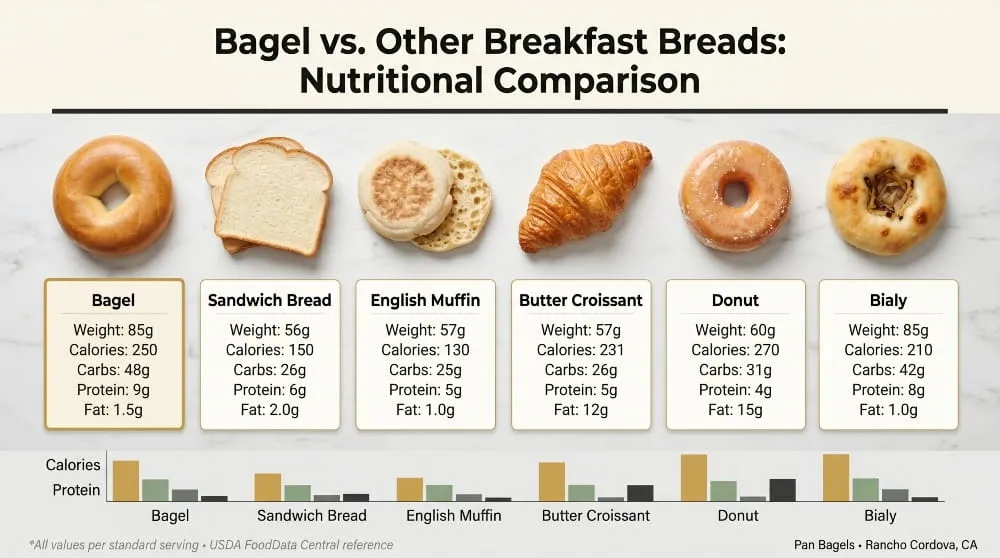
Bagel vs. Bread: Nutrition Compared Side by Side
The most common bagel nutrition comparison, bagel versus bread, is also the most frequently misframed. People typically compare a bagel to a slice of bread, which is not a meaningful portion equivalence. A standard plain bagel weighs approximately 105g. Two slices of standard white sandwich bread weigh approximately 50–60g combined. Comparing them calorie-for-calorie without accounting for weight produces the misleading impression that a bagel is dramatically less healthy than bread, when the reality is that you’re comparing different amounts of almost identical food.
At equivalent weights, a plain bagel and white sandwich bread have nearly identical macronutrient profiles: both are enriched wheat-flour products with comparable calorie density, protein content, and fiber levels per gram. The practical difference is portion: a bagel is a single, pre-portioned unit that weighs about as much as three to four slices of bread. When people eat a bagel, they typically eat the whole thing. When people eat bread, they typically eat two slices. That behavioral difference, not the food itself, is what drives the calorie gap in real-world consumption.
Where bread holds a genuine nutritional edge is in variety and accessibility of higher-fiber options. The commercial bread market offers a wider range of high-fiber, whole-grain, seed-laden, and reduced-calorie products than the bagel category, making it easier to find a 70-calorie, 3g-fiber slice of bread than an equivalent bagel. For bagels, the whole wheat and multigrain variants narrow that gap but don’t fully close it at the portion level.
Bagel vs. English Muffin Nutrition
The English muffin is the breakfast bread that most directly competes with the bagel as a morning platform, with the same basic function but a significantly different nutritional profile. A standard English muffin weighs approximately 57g and contains roughly 130–140 calories, 25–27g of carbohydrates, 4–5g of protein, 1g of fat, and 1–2g of fiber. Against a standard 105g plain bagel at 270–280 calories, the English muffin delivers approximately half the calories, half the carbohydrates, and about half the protein.
The English muffin’s advantage is almost entirely a function of size. Per gram of food, the two products are nutritionally comparable; the English muffin doesn’t have a superior nutritional density; it simply weighs less. The practical implication is that someone choosing an English muffin over a bagel is primarily making a portion decision, not a food quality decision. That’s a completely valid choice for calorie management, but it’s worth naming accurately: you’re eating less bread, not better bread.
Where the English muffin earns a genuine nutritional advantage is in the whole wheat variety. A whole wheat English muffin delivers 3–4g of fiber in a 57g package, a fiber density that outperforms even whole wheat bagels on a per-calorie basis. For people who prioritize fiber intake relative to calories, a whole-wheat English muffin is a more efficient vehicle than any standard bagel.
Bagel vs. Croissant Nutrition
The bagel versus croissant comparison produces the starkest nutritional contrast of any pairing in this guide; these two breakfast foods are built on fundamentally different formulas and deliver fundamentally different macronutrient profiles. A standard plain croissant weighs approximately 57g and contains roughly 230–240 calories, 26–28g of carbohydrates, 5g of protein, 12–13g of fat, and 1g of fiber. A standard plain bagel at 105g delivers 270–280 calories, 53–56g of carbohydrates, 10–11g of protein, and just 1–2g of fat.
The croissant is a laminated dough product, with layers of butter repeatedly folded into the dough during production, which is why its fat content is 6 to 8 times higher than a plain bagel per serving. That fat is predominantly saturated, contributing approximately 7–8g of saturated fat per croissant, or roughly 35–40% of the daily recommended limit in a single pastry. The calorie count is comparable to a bagel despite the croissant being roughly half the weight, meaning it delivers nearly twice the calorie density per gram, a meaningful difference for anyone managing portion-to-calorie ratios.
The bagel wins the head-to-head on protein (roughly double the croissant’s contribution), carbohydrate efficiency for sustained energy, and fat profile. The croissant wins on sensory experience; its buttery, flaky character is the result of that fat content, and no low-fat croissant replicates what makes a croissant worth eating. They’re different foods that happen to occupy the same morning meal slot, and choosing between them is ultimately a question of what your nutritional priorities are on a given day.
Bagel vs. Donut Nutrition
Bagels and donuts are often grouped in casual nutrition conversations as equivalent indulgences, and the comparison is worth making precisely because it exposes how inaccurate that grouping is. A standard glazed donut weighs approximately 50–60g and contains roughly 250–270 calories, 34–36g of carbohydrates, 3–4g of protein, 12–14g of fat, and less than 1g of fiber. A plain bagel at 105g delivers similar calories but dramatically different macronutrients: more than double the carbohydrates, nearly triple the protein, and a fraction of the fat.
The critical distinction is in what those calories are made of. A donut derives the majority of its calories from fat, primarily from the frying process, which saturates the dough with oil, and from sugar in the glaze or filling. A bagel derives the majority of its calories from complex carbohydrates, with protein as a meaningful secondary contributor. At equivalent calorie counts, the bagel delivers a nutritionally substantive meal platform; the donut delivers an energy spike with minimal satiety or micronutrient value.
This is not a moral argument about donuts; they’re a pleasure food that serves a clear purpose, but it’s a correction of the equivalence that diet culture sometimes draws between the two. A plain bagel and a glazed donut are not nutritional peers. The bagel carries more calories per serving, more carbohydrates, significantly more protein, far less fat, and a micronutrient profile from enriched flour that a donut’s fried dough doesn’t replicate. Choosing a bagel over a donut is, by most nutritional metrics, a meaningful upgrade rather than a lateral move.
Bialy vs. Bagel: What’s the Nutritional Difference?
The bialy is the bagel’s lesser-known cousin, a traditional Ashkenazi Jewish roll originating from Białystok, Poland, that shares the bagel’s cultural heritage but differs from it in two fundamental ways: it is never boiled before baking, and it has no hole, instead featuring a central depression filled with onion and sometimes poppy seeds. These production differences produce a lighter, less dense product with a meaningfully different nutritional profile.
A standard bialy weighs approximately 65–80g, noticeably lighter than a conventional bagel, and contains roughly 170–210 calories, 33–40g of carbohydrates, 6–8g of protein, 0.5–1g of fat, and 1–2g of fiber. The lower calorie and carbohydrate counts relative to a bagel are primarily a function of weight and density rather than a difference in flour type. Bialys are made from the same basic enriched wheat flour as white bagels, but the absence of the boiling step means the exterior crust doesn’t develop the same density. The overall product is lighter in structure.
The bialy’s nutritional advantage over a bagel is essentially the same as the English muffin’s: less food, fewer calories, proportionally less of everything. The bialy’s distinct character- the caramelized onion center, the softer chew, the lack of the glossy boiled crust- makes it a genuinely different eating experience rather than simply a smaller bagel. Nutritionally, it falls between a dinner roll and a bagel, making it one of the more calorie-efficient traditional Jewish bakery formats for those who want something authentic and satisfying at a more modest calorie cost.
Breakfast Bread Nutrition Comparison Table
All values are approximate and based on standard USDA FoodData Central entries and published nutritional data. Fresh-baked and artisan products will vary by producer.
Are Bagels Healthy? Nutritional Analysis
Bagels are neither a health food nor a junk food; they’re a calorie-dense carbohydrate with a solid protein contribution, meaningful micronutrients from enriched flour, and a portion size that requires awareness. Whether a bagel is healthy depends almost entirely on context: what kind, how large, what’s on it, and what the rest of your day looks like.
The Pros: What Bagels Do Well Nutritionally
The case for bagels starts with protein. At 10–11g per standard serving, a plain bagel delivers more protein than almost any other bread product at an equivalent calorie count, a function of the high-gluten flour and the boiling process that concentrates the dough structure. That protein contribution matters for satiety, muscle maintenance, and the overall macronutrient quality of a breakfast meal. A bagel with eggs or smoked salmon pushes that figure to 20–25g, which is a genuinely substantive protein meal by any dietary standard.
The micronutrient profile of enriched flour bagels is stronger than their reputation suggests. A standard plain bagel contributes 15–20% of the daily recommended intake for iron, 20–25% for several B vitamins, including thiamine, niacin, and riboflavin, and a meaningful percentage of the daily folate intake, a nutrient that remains chronically under-consumed across the general population. These aren’t incidental contributions; for people who don’t eat a nutritionally varied diet, a daily bagel quietly covers micronutrient gaps that might otherwise go unfilled.
Bagels are also, structurally, one of the most satisfying breakfast formats available. The combination of complex carbohydrates, protein, and, when toppings are added, fat and additional protein creates a meal that genuinely sustains energy for several hours. The density and chew of a properly made bagel engages the digestive process differently than lighter, airier bread products, contributing to a satiety response that a slice of toast or a muffin rarely matches. For people who struggle with mid-morning hunger, a well-constructed bagel breakfast is often more effective than lower-calorie alternatives that fail to hold off hunger between meals.
The Cons: Carbs, Sodium & Portion Reality
The nutritional limitations of bagels are real and worth naming without minimizing. The carbohydrate count, 53–58g in a standard bagel, 70–80g in a large shop bagel, is significant for anyone managing blood sugar, following a reduced-carbohydrate eating plan, or tracking macronutrients toward a specific body composition goal. These carbohydrates come predominantly from refined white flour in most conventional bagels, which means they digest relatively quickly and produce a faster glycemic response than slower-digesting carbohydrate sources. For people with type 2 diabetes or insulin resistance, that glycemic profile requires active management rather than passive consumption.
Sodium is the second meaningful concern. A standard plain bagel contains 430–500mg of sodium before a single topping is added, roughly 20% of the recommended daily limit in one food. Add cream cheese, smoked salmon, or a bacon, egg, and cheese build, and a single bagel meal can deliver 1,000–1,500mg of sodium. The American Heart Association recommends no more than 2,300mg of sodium per day for most adults, with an ideal target of 1,500mg for those managing hypertension, meaning a fully loaded bagel sandwich can consume a day’s worth of careful sodium management in one sitting.
Portion size is where the most significant practical challenge lies. The USDA reference bagel is 105g. The bagel most people are actually eating from a shop or deli is 130–160g. That gap, invisible on most tracking apps and nutritional databases, means people consistently underestimate their bagel calorie intake by 30–50%, which compounds meaningfully over time for anyone relying on accurate food logging. The bagel itself isn’t the problem; the misalignment between assumed and actual portion is.
How to Make a Bagel Healthier Without Losing the Joy
Making a bagel healthier doesn’t require abandoning what makes it worth eating. The most effective interventions are additive and behavioral rather than restrictive, improving what surrounds the bagel rather than diminishing the bagel itself.
Choosing whole wheat or whole grain over white flour is the single highest-return nutritional upgrade available, adding 2–3g of fiber and a broader micronutrient profile without meaningfully changing the calorie count or the eating experience for most people. If the texture difference matters to you, a whole wheat blend bagel, where whole wheat flour is present but not the exclusive ingredient, offers a middle path between the nutritional upgrade and the traditional character.
Topping selection has an outsized impact on the nutritional quality of the meal as a whole. Swapping regular cream cheese for cottage cheese increases protein by 10–12g at the same calorie level. Adding smoked salmon to any cream cheese preparation introduces omega-3 fatty acids and additional high-quality protein. Incorporating sliced tomato, cucumber, red onion, or avocado adds fiber, vitamins, and healthy fats without meaningfully raising the calorie count. None of these changes require sacrifice; they’re additions that improve the meal while preserving everything that makes a bagel worth eating in the first place.
Portion management is the intervention with the highest practical impact for most people. Eating a thin bagel, a mini bagel, or half of a large shop bagel rather than the full thing reduces carbohydrate intake by 30–60% while maintaining flavor. Pairing the reduced bagel portion with a protein-rich side, eggs, Greek yogurt, or smoked salmon produces a more nutritionally balanced meal than a full bagel eaten alone. The goal isn’t to eat less food; it’s to eat the same total volume with a better macronutrient distribution.
Bagels in a Balanced Diet: What Nutritionists Say
The professional nutrition consensus on bagels is more permissive than popular diet culture suggests, and it’s worth understanding why. Registered dietitians and nutrition researchers consistently distinguish between foods that are problematic in isolation and those that are problematic in dietary patterns, and bagels clearly fall into the former category rather than the latter.
No credible nutritional framework identifies bagels as inherently harmful. The Dietary Guidelines for Americans recommend that carbohydrates comprise 45–65% of total daily calorie intake, a range that comfortably accommodates a daily bagel as part of a varied diet. The concern among nutrition professionals isn’t the bagel itself but the dietary pattern it’s embedded in: a person eating a large buttered bagel as their only breakfast, followed by a refined-carbohydrate-heavy day, is experiencing carbohydrate and sodium accumulation, not a bagel problem.
What nutrition research consistently supports is the importance of overall dietary quality rather than the exclusion of specific foods. A 2020 meta-analysis in the British Medical Journal examining dietary patterns across 185 countries found that dietary risk factors, including excessive refined carbohydrate intake, were associated with disease risk when dietary patterns were characterized overall, not when individual foods were consumed as part of a varied, nutrient-dense eating pattern. A bagel eaten alongside adequate protein, fiber, vegetables, and healthy fats across the day is a culturally significant, nutritionally contributing food. A bagel eaten as the centerpiece of a nutritionally narrow diet is a different situation.
The practical takeaway from nutrition professionals is consistent: bagels can and do belong in a healthy diet for most people. The variables that matter are size awareness, topping quality, dietary variety across the rest of the day, and, for people with specific health conditions like diabetes, hypertension, or celiac disease, the particular type of bagel chosen. For everyone else, the evidence supports enjoying a well-made bagel without the nutritional guilt that diet culture has attached to it.
Fresh-Baked Bagel Nutrition: What Makes Pan Bagels Different
Fresh-baked bagels and packaged supermarket bagels share a name and a shape, but they’re produced differently, from different ingredients, with different results on your plate and in your body. Understanding that distinction is what separates a genuinely informed bagel nutrition conversation from one that treats all bagels as interchangeable.
Why Fresh-Baked Bagels Have Different Nutrition Than Packaged
The nutritional differences between a fresh-baked bagel and a packaged one begin at the ingredient level and compound through the production process. Commercial packaged bagels are engineered for a shelf life of seven to fourteen days, which requires preservatives, dough conditioners, and emulsifiers that have no role in a traditionally made bagel. Ingredients like calcium propionate, monoglycerides, DATEM, and azodicarbonamide are standard in mass-produced bagel formulations. These functional additives extend shelf stability but add nothing nutritionally and introduce compounds that a scratch-made bagel simply doesn’t contain.
A fresh-baked bagel made the traditional way, high-gluten flour, water, salt, yeast, malt, has an ingredient list that fits on one line. That simplicity has a practical nutritional implication: every calorie in a traditionally made bagel comes from a whole-food ingredient with a clear nutritional function, rather than from a processing aid included for commercial logistics. The macronutrient totals may look similar on paper. Still, the nutritional quality of those macronutrients and the absence of additives represent a meaningful difference for people who care about ingredient integrity alongside calorie counts.
The boiling step is the other production differentiator that affects nutrition in ways that don’t appear on a label. Authentic bagels are boiled in water, often with malt syrup or barley malt added, before baking. This process gelatinizes the exterior starch, creates the characteristic crust, and produces a denser interior crumb than an oven-only bake. That density is nutritionally relevant: the denser, more compact structure of a properly boiled bagel digests more slowly than the airy interior of a commercially produced bagel that mimics the appearance without the process. Texture, in this case, is a proxy for digestive behavior, and a properly boiled bagel sustains energy differently than a supermarket product that approximates its look.
Pan Bagels’ Ingredient Quality & What It Means for Your Macros
Pan Bagels in Rancho Cordova makes bagels the way bagels are supposed to be made, scratch-produced, fresh daily, without the shelf-life engineering that defines commercial production. That commitment to traditional production has direct nutritional consequences that show up in every bagel that comes out of the oven.
The flour matters. Pan Bagels uses high-gluten flour, the same type used by New York’s most respected bagel producers, which produces the elevated protein content that distinguishes a real bagel from a bread roll shaped into a ring. High-gluten flour contains significantly more protein than the all-purpose flour used in most home baking and some commercial bagel production, which is why a Pan Bagels bagel delivers a protein contribution at the higher end of the 10–11g standard range. That protein is structural; it’s what gives a properly made bagel its chew, density, and staying power.
The absence of preservatives and dough conditioners means what you’re eating is flour, water, yeast, salt, and malt, a short, clean ingredient list that requires no nutritional parsing. For customers managing food sensitivities, tracking macros, or simply preferring to know exactly what they’re consuming, that transparency is a meaningful practical advantage over packaged alternatives, where the ingredient list runs to 15 or 20 items. Fresh daily production also means no bagel sitting in a bag for a week before it reaches you; the nutritional profile you’re consuming reflects the ingredients as they were made, not as they’ve been preserved.
NYC-Style Bagels vs. Supermarket Bagels: Nutritional Reality
The gap between an authentic NYC-style bagel and a supermarket bagel isn’t just about taste; it’s about what the two products are at a fundamental level of production, and that difference has nutritional implications that most consumers never consider.
A supermarket bagel is designed around commercial constraints: it needs to be producible at scale, shippable without damage, shelf-stable for up to two weeks, and consistent across millions of units. Meeting those constraints requires the additives described above, but it also requires compromises in flour quality, fermentation time, and production method. Most commercial bagels skip or significantly shorten the boiling step; some use steam injection in the oven as a substitute, producing a product that looks like a bagel but lacks the structural density that boiling creates. The result is a lighter, airier interior with a faster digestive profile and less of the chew that makes a real bagel satisfying.
An NYC-style bagel, the kind Pan Bagels produces in Rancho Cordova, is a different product category. The high-gluten flour, the full boil, the scratch production, and the daily fresh bake produce a bagel that weighs more, chews longer, and sustains longer than its supermarket counterpart. That additional weight, typically 120–150g for a proper shop bagel versus 90–105g for a packaged one, means more protein, more B vitamins, and more of the complex carbohydrate structure that provides sustained energy rather than a quick spike.
For Rancho Cordova residents, this distinction is directly accessible. Pan Bagels at 4022 Sunrise Blvd brings the nutritional integrity of a traditionally made NYC-style bagel to the Sacramento area, scratch-made daily, boiled properly, built from a short ingredient list that reflects how bagels have been made for over a century. When the nutritional quality of what you’re eating matters as much as the flavor, there’s a meaningful difference between driving to the supermarket bread aisle and walking into a real bagel shop. In Rancho Cordova, that option exists, and the bagels are worth knowing about.
Frequently Asked Questions (FAQ’s)
How many calories are in a plain bagel?
A plain bagel contains approximately 270–280 calories at the standard 105g serving size. A large fresh-baked shop bagel weighing 130–150g runs closer to 350–420 calories, which is why the source and size of your bagel matters more than any generic database entry when tracking intake accurately.
Are bagels high in carbs?
Yes, bagels are high in carbohydrates; a standard plain bagel contains 53–58g of carbohydrates, equivalent to roughly three to four slices of white sandwich bread. That carbohydrate load comes primarily from refined wheat flour, which digests relatively quickly. Whole wheat, whole grain, and low-carb bagel alternatives reduce that figure meaningfully, but a conventional bagel is an unambiguously high-carbohydrate food.
Is a bagel healthier than bread?
Compared gram for gram, a bagel and white bread are nutritionally similar; both are enriched wheat flour products with comparable calorie density, protein, and fiber per gram. The practical difference is portion: a standard bagel weighs as much as three to four slices of bread, meaning a single bagel delivers significantly more calories and carbohydrates than the two slices most people eat in a bread serving. Choosing whole wheat in either format improves the nutritional profile of both.
How much protein does a bagel have?
A standard plain bagel contains 10–11 grams of protein, more than almost any other bread product at an equivalent calorie count. That protein comes from the high-gluten flour used in traditional bagel production, which is why an authentic fresh-baked bagel typically delivers more protein than a commercial packaged equivalent made with lower-gluten flour blends.
What is the most nutritious type of bagel?
Ezekiel bagels, made from sprouted whole grains and legumes, are the most nutritionally complete option available, delivering 5–6g of fiber, a more complete amino acid profile than wheat-only bagels, and no added sugar. For those who prioritize the traditional bagel experience, whole wheat and pumpernickel are the strongest conventional choices, offering 3–5g of fiber and a broader micronutrient profile than standard white flour varieties.
Does toasting a bagel change the nutritional value?
Toasting a bagel does not meaningfully change its calorie, carbohydrate, protein, or fat content. The primary effect of toasting is moisture loss; the bagel becomes slightly lighter as water evaporates, but the macronutrient totals per gram remain essentially unchanged. The one minor exception is that high-heat toasting can reduce some heat-sensitive B vitamins marginally, but the effect is too small to be nutritionally significant in practice.
Is a scooped bagel actually lower in calories?
Yes, but by less than most people assume. Removing the interior dough from a standard bagel typically removes 25–50g of dough, reducing calorie content by approximately 50–100 calories and carbohydrate content by 10–20g. The reduction is real, but it only holds if topping quantity stays constant; a scooped bagel filled generously with cream cheese to compensate for the missing interior can easily replace every calorie removed, negating the benefit entirely.
How many carbs are in an everything bagel?
An everything bagel contains approximately 52–55g of carbohydrates per standard 105g serving, marginally lower than a plain bagel in some formulations because the seed-and-seasoning topping displaces a small amount of dough surface area. The difference is negligible in practical terms. The more nutritionally relevant distinction of an everything bagel versus a plain one is sodium, which runs 50–120mg higher due to the coarse salt in the seasoning blend.